
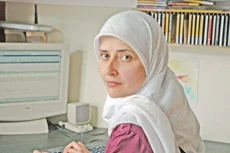
MUSLIMS throughout the world face challenges. There are many problems and there is a lot of negative media coverage about Muslims, which can be overcome with positive projects, according to Sarah Joseph, who has been involved with media for more than a decade and now edits the first ever magazine that reflects Muslim life in modern Britain. Called emel — em standing for ‘M’ and el for ‘L’ — Muslim Life, it has gained wide popularity in less than a year of publication.
“As Muslims, we get a lot of unfair and hostile coverage from many quarters — be it a bad program, a negative newspaper piece, or the continued vitriolic attack from certain journalists. However, we also need to create pro-active projects that contrast with the negativity of the day,” Sarah said in an online interview.
A mother of three, she has a B.A. (Hons.) degree in religious studies from King’s College, London. She is a winner of the 1999-2000 Prince of Wales Chevening/King Faisal Foundation Scholarship, and has done post-graduate research on Britons embracing Islam.
Some surveys have shown that nearly 70 percent of non-Muslims in Britain know nothing about Islam. Emel has decided to take up that challenge.
Sarah said that as a person born into an English family who then chose Islam she felt a special responsibility to build bridges between the two worlds she loves — the world of her birth and the world of her choice. She said enthusiastically that the people in Britain would respond positively to that which is good. “The British people are a benevolent people, and they respect differences and usually help the underdog,” she emphasized.
“We need to talk to the people. And we need to speak in the language of the people. When I look at the stories of Musa and Yusuf (peace be upon them), I feel they are very connected to our present situation as Muslims in the West. We are here in the West, some of us indigenous white Muslims, and certainly most of us British-born. We have to talk to the people in their own language and, like Yusuf, be of real benefit to the society we find ourselves in,” she elaborated.
In 1994, she was asked to edit a magazine called Trends, at that time the first magazine to target young Muslims in the United Kingdom. It used images in a big way, covered issues in a popular way. She was its third editor, and the first female editor of a Muslim magazine in the UK.
Emel is a very different publication. The 100-page full-color glossy magazine that has topics ranging from cookery to celebrities, interiors, food, gardening, clothes, sport, art, music, addresses diverse issues, covers news and current affairs, travel, health and education, parenting and relationships, finance and environment, is surely a groundbreaking venture for today’s market. It hopes to break negative stereotypes and promote a sense of pride. With snappy graphics, quality photographs and an attractive layout Emel may appeal to non-Muslims as well.
It talks about Islam in a dynamic, vibrant way; showing Islam as a living reality in Britain and the rest of the Western world; creating a new culture of expression that blends tradition with the modern world. Whilst many Muslims have recognized the need for high-quality contemporary Muslim publications, few have taken up the challenge.
“We’re absolutely bowled over by the reception and the reaction. It has been a vision, a dream of a small group of people of a high-quality magazine, a magazine that covers so much, and we’ve tried to realize that vision the best we can. People have been so impressed. They can’t believe that Muslims have produced this, that we’ve produced something of such high quality,” said Sarah, who has lectured on Islam in Britain and internationally. She has also appeared on radio, done a lot of work for the World Service and for BBC radio, and worked as a specialist researcher on the BBC Islam Season in 2001.
She said that challenges have to be seen as a way to grow. “We have to stop feeling like victims and start feeling empowered to do good and work righteously. We have to open ourselves up and decide that we want to create a civilization based upon righteousness, justice, a love for the people of the world and an understanding of our responsibility to the planet as vicegerents on Allah’s earth,” she said.
Sarah said Muslims have begun to see themselves two dimensionally — reacting always to negativity, reacting always to stereotypes, which is not healthy for a community to exist in this very narrow box that is always putting out the fire caused by reaction to current events. “We need to say look, we celebrate Muslim life, we need to be proud of what we are and what we’ve achieved and what we are achieving — what we’ve achieved through history — that we wouldn’t have the tremendous European and western civilization today if it wasn’t for the great Islamic civilization of the past,” she said.
“I believe at times of greatest difficulty the human capacity for good rises up and produces beauty. I see so many examples of this at the moment. We have growing art and music movements in the UK right now, we have tremendous Islam awareness projects, we have major Muslim contributions to the peace movement, as well as Muslim contributions to the environmental movement, as environmental degradation is a very serious danger to our planet. Everywhere I look I see Muslims participating in mainstream society in a powerful and energetic way, and that is wonderful,” she said.