
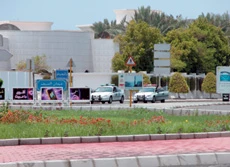
JEDDAH, 10 August 2004 — Jeddah’s youth, the “shabab” as they are known locally, have to find a new place to hang out — away from Tahlia Street. The once popular section of the street between Prince Sultan Street and Al-Malek Road has recently received a great deal of attention from the traffic police, thereby leaving the youth looking for a new place to congregate and display their souped-up cars on weekends. Greater police presence, the implementation of speed traps, use of undercover cars and spontaneous checkpoints have left the young men fed up.
“We have to find a new place to go,” said Fahd Al-Zahrani, 18, a regular on Tahlia. “We used to park in the service lane away from the flow of traffic, and check out each other’s cars. Seeing the latest cars with the latest in aftermarket accessories ordered from abroad was the highlight of the weekend. It was harmless fun, and we weren’t really bothering anyone.”
Mishal Al-Musaed, 21, has been a regular on Tahlia, for years. He tells a different story. “It has always been the cruising street for as long as I can remember. A popular gathering spot it is, but with the people come the problems. I have seen many fights, chases, races and crashes just on that stretch of road,” he told Arab News, as he pointed west toward Malek Road from the Feyfa parking lot.
The 1,300-meter, four-lane stretch of moderately well-paved asphalt has been the favorite racing spot among young, and not-so-young, drivers for years. With no traffic lights or speed bumps, motorists in exotic Italian and German automobiles have reached speeds in excess of 190 kilometers per hour.
To combat this, the traffic police are using the shabab’s favorite spot, the service road that runs alongside the main road, and what looks like an old broken-down car. Inside the harmless looking jalopy is a traffic policeman with a radar gun and a radio. As a speeding car whizzes past and is picked up on radar, the policeman calls the vehicle’s description and its speed to his colleagues, waiting with their safety lights off approximately half a kilometer ahead. With no turns or exits prior to the checkpoint, the speeding motorist finds himself trapped. Speeding fines can be as high as SR900 with the average being SR300.
Arab News spoke to a traffic police lieutenant who asked to remain anonymous. The lieutenant, one of those in charge of Tahlia, confirmed that the crackdown was timed to coincide with the rush of visitors to Jeddah during the summer months. “The fastest speeding ticket we have given since the beginning of the campaign was for a speed of 120. We have had no accidents or problems this summer,” he told Arab News.
“Before the summer, we realized that something had to be done to make that road safer and to curb the accident rate. We also realized that with the opening of so many malls, more and more cars and people would come. By stopping the unnecessary traffic caused by the kids cruising, we help prevent traffic jams and other problems. It seems to be a success.”
He went on to say, “Before the summer holiday, there was an accident in which two motorcyclists went down, one of whom was seriously injured. We have had several minor accidents, mainly at the roundabouts but fortunately no recent fatalities.”
The crackdown comes as bad news for the shabab.
“Wherever we find a place to congregate, they just chase us away. We’re having to move our gathering places further and further out of the city. Al-Mohammediyah District and Obhur are the new spots, but it’ll only be a matter of time before someone gets hurt or killed on the unlit roads of Obhur and then we’ll be chased off to another spot,” he added.
Traffic police target the young drivers on Tahlia, whose cars are often found to be in violation of the law. By avoiding places where police tend to operate, drivers with aftermarket parts and accessories can get to keep them longer since many of them are illegal.
“It’s just better all around for us to avoid the police presence, not because we are criminal or have something really bad to hide; we just don’t want traffic tickets or to have our cars impounded.”

