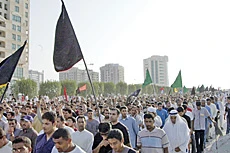
MANAMA, 14 August 2004 — More than 10,000 people led by religious leaders, members of Parliament and political figures took to the streets of Manama yesterday to protest the US blitz of the Shiite holy cities in Iraq.
The late afternoon march brought traffic to a halt on one side of the highway leading to the capital’s commercial center.
The protesters marched down a major highway in the Seef district of Manama chanting anti-US slogans. They demanded a halt to hostilities and held the United States responsible for any “desecration” and destruction that results from the attack.
Women marchers, covered head to toe in black robes, followed the men, all of them demanding that America leave Iraq and let the people decide their own future.
In Najaf, nine days of fighting between US forces and Moqtada Sadr’s militia was suspended yesterday for truce talks. Before Thursday, the US military has estimated that hundreds of insurgents had been killed in the Najaf fighting since it began last week, but the militants dispute the figure.
The protesters called on the Iraqi political factions to resolve their differences through dialogue to spare the Iraqi people further pain and spare Iraq further destruction.
The head of Al-Wefaq Islamic Society, Sheikh Ali Salman, said that the march was a peaceful expression of the Bahraini people’s feelings to the developments taking place in Iraq. “We could not stand and watch and the unfolding situation in Iraq left us no choice but to react to it,” he said. “This is a first step and if the situation remains or deteriorates we will take further action.”
Sheikh Salman emphasized that the protests would be peaceful and that the only combat front was in Iraq. “We support the right of the Iraqi people to resist the occupation and the occupation forces must set a time for their departure,” he said.
He said Al-Sadr, as an Iraqi, has more right over his country than the Americans.
“Whatever the problem is, the Iraqis should be able to handle it on their own,” Salman said. “They don’t need outside help.”
MP Sheikh Mohammed Khaled, who also took part in the march, said that his participation aimed to send a message to the US administration that all Muslims — Sunni and Shiite — were one in their opposition to the occupation and “desecration” of religious sites.
“The march is a message to the US administration from the Bahraini people that we oppose their tyranny and injustice toward our Muslim brothers in Iraq or anywhere in the world,” he said. “Their actions against the Muslims in Najaf, Guantanamo, or any other country amounts to oppression.”
“We condemn the desecration of holy cities in Najaf because I fear these actions are only a test balloon for further attempts to desecrate other holly sites,” he said.
Abdulrahman Al-Naimai, the head of the National Democratic Action Society, said that the march was a show of solidarity with the Iraqi people against the occupation.
“The Bahraini people stood by the Iraqi people against the tyranny of the previous régime and today we stand with them against the tyranny of the occupation,” he said. “This march is only a simple expression of solidarity with the Iraqi people who are fighting the occupation and seeking to end it.”
Yesterday’s march was organized by leading Shiite clergymen who issued a call for it late Thursday night.
In May a similar protest against the desecration of holy sites in Najaf and Kerbala took place in the same area and ended with clashes between police and rioters after police fired teargas to disperse the crowds. The clashes that left scores of people injured resulted in a decision by King Hamad to replace the minister of interior at the time.
The king also emphasized his support to peaceful expression of views by legal means.
Yesterday police diverted traffic away from the march, which ended peacefully.