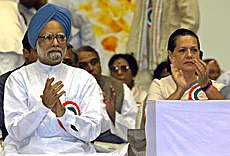
NEW DELHI, 22 August 2004 — Indian Prime Minister Manmohan Singh yesterday said his three-month-old government would give top priority to tackling inflation and that “hard decisions” would have to be taken, eschewing “competitive populism”.
Addressing the All-India Congress Committee convention here the prime minister said his government was committed to pursuing “higher economic growth” that would also be “equitable and people-centered”.
“(But) we will give highest priority to taming inflation,” he told some 1,500 delegates to the meet at the Talkatora Indoor Stadium here attended by party President Sonia Gandhi, Cabinet ministers and party functionaries.
“With the improvement in rainfall and as a result of steps taken by us on petroleum taxation, we are confident of bringing the (inflationary) situation under control. Let there be no doubt on that score,” he said.
“If, despite these favorable conditions, there is some pressure on the price front it is largely on account of either international factors or a consequence of policies pursued by the previous government with respect to the management of money supply and energy pricing,” Manmohan said.
The annual wholesale price inflation shot up to a three-and-a-half year high of 7.96 percent for the week ended Aug. 7 from 7.61 percent in the previous week, mainly due to higher energy costs. The prime minister called for improved returns from public enterprises, the streamlining of the tax administration and the management of public debt with an eye on sustainability.
“This is not an easy task. Hard decisions will have to be taken by governments at all levels and all political parties must understand this,” he said.
Stating that “the country can ill afford competitive populism,” he urged the chief ministers of states governed by the Congress to show particular discipline in this regard and set an example for all others.
He also talked about other challenges facing his government, notably internal security and law and order.
“The major areas of challenge for our country are cross-border terrorism in Jammu and Kashmir, insurgency in some parts of northeast and Maoist violence in some states.”
He said his government was willing to talk to any group. “In pursuit of peace and normalcy, our government has repeatedly expressed commitment to talk to any group provided they abjure the path of violence.”
“We must also deal with underlying feeling of alienation among sections of people, a majority of whom want to live in peace and tranquillity.”
In reference to the crisis in Manipur due to the people’s agitation against an anti-terror law seen as repressive, he emphasized the need for people-centered development “without losing sight of human rights concerns.”
“We are committed to paying equal attention to the genuine concerns of the people and redressing their grievances, whether in the northeast or Jammu and Kashmir or other parts of the country.”
Singh said while his government was committed to “carry forward the composite dialogue with Pakistan, including issues related to Jammu and Kashmir”, the previous National Democratic Alliance (NDA) government’s peace initiative “seems to have been an ad hoc exercise without clarity or a road map”.
Addressing the session Sonia accused the opposition Hindu nationalist Bharatiya Janata Party (BJP) of subverting the people’s mandate and urged her party to learn lessons about falling prey to the arrogance of power. Sonia launched a blistering attack on the BJP as well as its mentor Rashtriya Swayamsevak Sangh (RSS).
“The verdict was a clear, categorical and decisive rejection of the BJP and the National Democratic Alliance (NDA) — their arrogance, lust for power and pursuit of personal profit blinded them to reality,” said Sonia.
“The BJP did not expect to lose. It lost. (It) is behaving in a manner that subverts the mandate.”
Commenting that the BJP’s “Chintan (brainstorming)” meets had become “Chinta (worry)” conclaves, she said: “They believed they had attained political immortality. Let us be clear — the BJP has not accepted its rejection by the people, by the ‘Aam aadmi’(common man).”
Sonia urged her party men to avoid showing off wealth and to adopt a lifestyle of simplicity and honesty.
She regretted that her party leaders had not followed her directives for a code of conduct and simplicity she had suggested two years ago.
“The fight against poverty cannot be led by those blatantly displaying money power,” she said, expressing “pain” that a letter stipulating such a code she had sent to chief ministers and state party chiefs had “remained on paper only”. — Additional input from IANS.