BAGHDAD, 27 August 2004 — Moqtada Sadr agreed yesterday to a peace initiative from top Shiite cleric Grand Ayatollah Ali Husseini Al-Sistani. “Mr. Moqtada Sadr agreed to the initiative of Al-Sistani,” Hamed Al-Khafaf told reporters at a news conference outside the house in Najaf where Sistani is staying.
The agreement was reached during a meeting between the two clerics.
Sistani returned earlier in the day with a new plan to end the violence. The plan called for Najaf and Kufa to be declared weapons-free cities, for all foreign forces to withdraw from Najaf and leave security to the police, and for the government to compensate those harmed by the fighting. “It’s the same initiative that we had proposed... almost the same has been agreed upon,” Khafaf said.
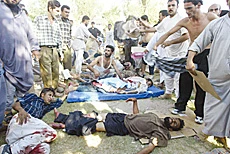
The agreement came on a day when 74 people were killed and hundreds injured as a mortar hit Kufa’s main mosque and marchers were fired on. And at least 15 Sistani supporters were shot dead in Najaf and 65 wounded when gunmen opened fire at police who were trying to control a crowd, prompting police to shoot back, witnesses said.
“Suddenly armed men joined our group and fired at the police. The police started firing everywhere,” witness Hazim Kareem said at Najaf’s hospital, where bodies dripping with blood were piled on stretchers.
A hospital worker added: “Go look at the morgue, it’s full.”
A 24-hour cease-fire was declared in Najaf on the order of Prime Minister Iyad Allawi as soon as Sistani arrived. The local governor said hostilities would resume if a solution to the standoff against Sadr’s Mehdi Army militia was not found by then.
Before the negotiations started, Sadr spokesman Ahmed Al-Shaibany, speaking very briefly to reporters, accused the Americans of taking advantage of the truce to target Mehdi Army fighters. “If the Americans start shooting, then you should return fire. Otherwise, you should never open fire at the Americans,” said Shaibany via a loudspeaker. Witnesses said US forces had retreated slightly and the Mehdi Army fighters were still out in the streets, patrolling their ground. Those Sadr supporters who crossed an unofficial demarcation line faced gunfire.
Sistani left the southern city of Basra in the morning in an armored car traveling in a 30-vehicle convoy that was greeted by thousands of enthusiastic supporters along the way. He arrived in Najaf just before 3 p.m. and went directly to one of his houses in the Al-Sa’ad neighborhood. With military operations called off, an enormous crowd forced its way into Imam Ali Mosque, which has been cut off from the outside world by heavy US bombardment and tank fire since Wednesday. Sadr has used the mosque has the headquarters of his militia since his spring uprising against foreign troops.
“We answered the call of Sistani who ordered us to follow to Najaf to break the siege. Police sort of tried to arrest us, but there was nothing they could do. It’s the end of the siege,” said one demonstrator.
Meanwhile, kidnappers of seven employees of a Kuwaiti company said in a video statement they would release the captives once their employer halted operations in Iraq, Al-Arabiya reported. The group said it would free the three Kenyans, three Indians and one Egyptian in response to an appeal by a top Indian diplomat. It only demanded that Kuwait and Gulf Link Transport Company end its work in Iraq.
— Additional input from agencies