BAGHDAD, 28 August 2004 — Supporters of Moqtada Sadr yesterday vacated the Imam Ali Mosque in Najaf hours after a peace deal between Sadr and Iraq’s highest Shiite cleric, Grand Ayatollah Ali Husseini Al-Sistani, was sealed.
“Now the shrine compound has been evacuated and its keys have been handed over to the religious authority,” Hamed Al-Khafaf, an aide to Sistani, told Al-Arabiya television.
Sadr issued a statement broadcast over the mosque’s loudspeakers, ordering his Mehdi Army militia fighters to lay down their arms and leave Najaf and neighboring Kufa. “To all my brothers in Mehdi Army... you should leave Kufa and Najaf without your weapons, along with the peaceful masses,” his statement said.
Dozens of militants piled Kalashnikov rifles in front of Sadr’s office. But others kept their weapons to fight another day.
Some fighters carried Kalashnikovs in plastic bags to take them home, while others wrapped mortar and rocket-propelled grenade launchers in canvas before stashing them away in safe houses in the Old City.
“They will hide their weapons but will not hand them over to the police or to the army,” Ahmed Al-Shaibany, Sadr spokesman, said. “The Americans thought that they could exterminate the Mehdi Army, but our fighters are still here. They will be able to go back to their work while remaining an army.”
The five points of the peace agreement between Sistani and Sadr are:
—Najaf and Kufa must be disarmed and all armed elements in these cities must leave and never return.
— The Iraqi police are to be responsible for restoring security and peace in the two cities.
— The US-led multinational force must withdraw.
— The Iraqi government must pay compensation to those who have suffered during the crisis.
— All parties and political, social and ideological movements must join in a process leading to general elections and total sovereignty, and must create an environment favorable to this process.
Iraqi forces took control of the Old City and dozens of Iraqi police and national guardsmen deployed around the mosque compound in the afternoon, but did not enter. Some residents of the devastated neighborhood waved to them and yelled out, “Welcome. Welcome.”
But US forces still maintained their positions around the mosque and jet fighters flew overhead, but the fierce clashes of previous days had ended and most parts of the city were calm.
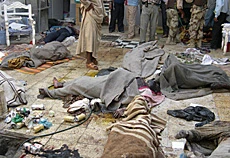
The fighting over, 25 bodies were discovered in the basement of a Sadr court. Hours after taking control of the mosque neighborhood, Iraqi police rushed to a hotel housing journalists and offered them access to the makeshift court.
“Cover your noses. This is where his Mehdi Army slit the throats of people and then left them to rot,” one said.
Inside the court, about 200 meters from the mosque, were bloated, blackened corpses covered in flies.
One was missing fingers. They could have been chopped off, or blown off by a mortar or a rocket. Some had gashes in their necks. It was impossible to tell whether their throats had been slit or they had suffered wounds or natural decay.
The US-backed Najaf police accuse Sadr of handing down death sentences in a makeshift, illegal court. The young cleric sees himself as a champion of the impoverished and condemns the interim Iraqi government as American puppets.
The court’s chief administrator, Hashim Abu Reef, denied the police accusations. “We denounce this charge. This government is very capable of trying to frame us. Those corpses are our fighters which we could not wash or move because the Iraqi government and Americans cut off the electricity and water,” he said. “There is also one woman who was passing by the shrine and killed by a sniper. We can identify each and every body.” The cleric said the bodies had been there for two days.
As reporters and residents stood over the decaying bodies, police held up a carton of beer and gin.
“Is this the Mehdi Army’s version of Islam?” a policeman asked as he hurled a box of cans.
But Reef said the Mehdi Army militiamen did not consume alcohol.
Late yesterday, Arabic television station Al-Jazeera said the bodies of two Turkish hostages had been found north of Baiji, apparently shot dead. At least four Turks have been kidnapped in Iraq this month, two on Aug. 5, one on Aug. 7 and another on Aug. 16.
On Thursday, Al-Jazeera reported that it had received images that showed the killing of an Italian hostage, but the station said it had declined to broadcast the footage out of sensitivity to its viewers. Yesterday Italy confirmed the killing of freelance journalist Enzo Baldoni.
In an interview with RAI state radio, Italian Foreign Minister Franco Frattini said the killing was “an act of barbarity, a horrendous act that has struck a courageous journalist who had gone to Iraq to help the Iraqi people.”
But Frattini echoed Prime Minister Silvio Berlusconi’s assertion that Italy would maintain its troop presence in Iraq despite Baldoni’s killing. “The Italian undertaking in Iraq cannot and should not change,” Frattini told RAI.
Yesterday Al-Jazeera said militants who had kidnapped two relatives of Iraqi Defense Minister Hazim Al-Shalaan had released one of them. It said the group calling itself the “Brigades of God’s Anger” freed Salah Hassan Zeidan Lamie, a relative of Shalaan by marriage, after Iraqi police met their demand to release Ali Sumeisim, an aide to Sadr.
There was no word on the other kidnapped man — a blood relative of Shalaan — who was captured by the group.
A US warplane bombed the restive city of Fallujah yesterday. The plane dropped at least two bombs in the eastern neighborhood of Al-Askari, witnesses said.
In Baghdad, guerrillas attacked a US patrol four times with grenades wounding 12 US soldiers. Four suspects were detained on suspicion of involvement in the attacks, the army said in a statement.
— Additional input from agencies