
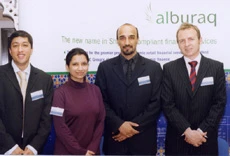
LONDON, 2 September 2004 — Britain’s two million Muslims can from today apply for a pioneering home financing scheme which is both flexible and strictly Shariah compliant.
The Alburaq Shariah-Compliant Home Financing scheme is based on the Islamic concept of diminishing Musharaka (co-ownership or equity participation), and is now available via Alburaq or at selected high street branches of Bristol & West.
Alburaq is the brand under which the Arab Banking Corporation (ABC) is offering retail Islamic banking products comprising home finance, property finance for non-UK residents, buy-to-let, community projects, savings and investments, education finance, and consumer finance, to Muslims in the UK and globally. In May 2004, ABC agreed to provide Islamic home finance in the UK in partnership with the Bristol & West, one of the UK’s foremost mortgage banks. Bristol & West is providing the financing and full back-office support services, while ABC is marketing the product in the country.
The word Alburaq conjures up sheer emotion and awe in many Muslims. The name was chosen to represent many of the Islamic values which ABC wishes to introduce, including trust (amanah), reliability and stability.
The scheme also brings together the best of British financial engineering and expertise and Islamic financial principles, which prohibits the charging and giving of interest.
This scheme, says Keith Leach, senior manager at ABC International Bank, is “tailored to the needs of the Muslim community in the UK,” which today number almost 2 million, mainly from Pakistan, Bangladesh, India, Turkey, Morocco and the Gulf states.
Julie Blunden, head of market development at Bristol & West, explains: “We have worked closely with ABC and their Shariah board for the past 18 months to ensure we provide a product which offers the strictest Shariah compliance and yet is modern and flexible and that will not place our Muslim customers at any financial disadvantage in comparison with conventional interest mortgages. Muslims and others interested in faith-based ethical mortgages will take out the Alburaq Islamic home financing scheme in the name of Bristol & West, but ABC International Bank is fronting the marketing, sales, and Shariah compliance.
Customers can get further comfort in the knowledge that ABC has a representative and independent Shariah Advisory Board, whose principal is Sheikh Nizam Yaquby, a noted Bahraini Islamic Fiqh (jurisprudence) scholar, and two home-bred British Islamic scholars, Mufti Abdul Kadir Barakatulla, Imam of the Finchley Mosque; and Mufti Mohammad Nurullah Shikdar, Imam of the Tunbridge Wells Mosque.
Leach stresses that “the net cost of an Alburaq package is broadly comparable to the cost of an equivalent mortgage, thanks in part to last year’s UK budget which exempted co-ownership schemes along these lines from the need to pay double stamp duty. Our view is that the market is growing, and as more products become available, there will be more interest in Islamic home financing and products.”
Islamic home financing is based on three types of contracts - diminishing Musharaka; Ijara (leasing); or Murabaha (mark-up). While all three are allowed under Islamic financial principles, the preferred contract for the Alburaq mortgage is diminishing Musharaka.
According to Sheikh Nizam Yaquby, “the diminishing Musharaka offers the most viable solution for housing finance. This particular contract has been successfully implemented by mortgage providers in the US, UK, and Pakistan.”
Under this mode, the financial institution and client jointly purchase the house. The ownership of the house is split between the bank and the customer; and it is agreed that the customer will purchase the share of the bank in the house gradually, thus increasing his own share until all the share of the bank is purchased by him so as to make him the sole owner of the asset after a specified period. But during the financing period, the bank’s share is leased to the customer who pays rent for using the bank’s share in the asset. This contract, stress ABC International Bank and Bristol & West, offer an optimum mix of risk and return for the financial institutions.
The Alburaq scheme, which typically has a tenor of up to 25 years, offers two payment options to the customer. In the first option, the rent is fixed for an initial period of six months, and is then reviewed every six months. In the second option, the rent is fixed for an initial period of two years, and is then reviewed every six months.
Muslim customers in the UK have found that the set-up costs and rates of financing for Islamic home financing schemes tend to be higher than those of their conventional counterparts. This is because there is no legal and regulatory level playing field for both types of mortgages.
However, the Labour government through its social and financial inclusion policies, is proving to be the great enabler of Islamic finance in the UK. Chancellor of the Exchequer Gordon Brown has already removed the additional stamp duty cost incurred in alternative property finance schemes in the Finance Act 2003, which became effective last December.
The market, however, is keen on three further legal reforms, which would put Shariah-compliant home financing schemes on a level playing field with their conventional counterparts. Currently, the Ijara-based home financing scheme attracts a 100 percent risk-weighting, because it is considered to be akin to conventional lease finance which incur a 100 per cent risk-weighting, which is the amount of money banks and building societies are legally required to set aside to cover their lending.
Conventional mortgages carry a 50 percent risk weighting because they are regarded as established, necessary and major financial products which carry less risk than other financial products. Islamic home financing providers are lobbying the Financial Services Authority (FSA) and the UK Treasury to treat the Musharaka and Ijara home financing schemes the same as conventional mortgages in terms of risk weighting.
Another reform is the right-to-buy under the low cost housing ownership scheme (LCHO), which comes under the purview of the Office of the Deputy Prime Minister (ODPM). Deputy Prime Minister John Prescott has set up the LCHO Task Force, which in a recent circular confirmed that the ODPM is considering how to enable Shariah home finance to be used for LCHO schemes.