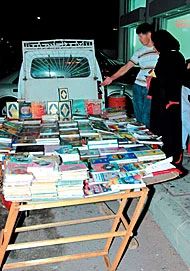
JEDDAH, 6 September 2004 — Walking down the crowded shopping center, the street is full of buyers, chain stores selling make-up, perfumes, clothes and food. An unfamiliar sight will meet your eye — a small pickup truck parked near one of the stores, which is full of books displayed for all to see. The books contain Islamic titles, family, health and children’s magazines.
Now this is a strange sight to me since in Jeddah, people are not used to the idea of bookstores, at least not on the pavements. In this country, reading is not a widely appreciated pastime. So with all the bustle of the shopping malls in Jeddah, this bookseller seems to me as if he has arrived in the land of consumerism from another planet.
Sitting near the truck a young man in his 20s is chatting to the man next to him. As I approach him, soon he is guiding me through the small collection. I ask: “How long have you been selling books?” He answers: “A few months.”
The man is not at first comfortable about being interviewed; he says the municipality might crack down because he does not have license. I ask him why he doesn’t get one and he smiles and says, “Well, I am just a simple bookseller; I can’t compete with the tycoons here.” True — and since his merchandise is not the kind available in Jeddah shopping centers, he makes good sense.
Mahdi (not his real name) is a high-school graduate. He began selling books when his friend who works in a bookstore, had the idea of selling books on the street. He says that he likes the idea and the two have been working together from the beginning. Now they have other cars selling books in three other areas of Jeddah and that his customers are men, women and children. He says that he gets lots of customers and this is encouraging but he expects an increase in Ramadan.
He picks up titles that he thinks people will be interested in, but sometimes when his customers ask for certain titles, he gets them. Islamic books are a sure sell as well as children’s books. For him, the business is a good one; he makes a living out of it and he enjoys reading the books while waiting for customers.
Mahdi has part-time helpers — two young girls who usually sell chewing gum to passersby. They now help him sell books. Looking nearby at another vendor displaying video games for kids, I ask him if his merchandise is as desirable as that and he says, “Well, you know those games sell a lot, but I have my customers and I am happy with them.”
I look at the shoe store next to his pitch, filled with glittering ephemera and “must have” buys, and compare it with the simple little truck filled with books. Mahdi is selling something infinitely more durable and valuable but far less fashionable. It is a brave, and to me worthy, decision. If only one day it could be as fashionable to buy a book as it is to buy shoes.