NEW YORK, 7 September 2004 — One of the biggest dangers for airline travelers is a suicide bomber who brings onboard a block of explosives the size of a cake of soap. Screening devices would be hard-pressed to find it, unless the airport is using a new type of explosive detector that filters air to find traces of combustible materials.
England’s Heathrow Airport is using them; so are airports in Germany, Canada and Senegal, to name a few. And now some American airports may install them as early as this month. These ‘people puffers’ are also being considered for use at sports arenas and railway stations.
The National Park Service put these sophisticated sniffer machines into use at the Statue of Liberty when it reopened last month after a period of renovation.
Relatively unobtrusive, the machine sniffs particles and detects trace explosives even if they are hidden inside a cake, sausage or stuffed grape leaves.
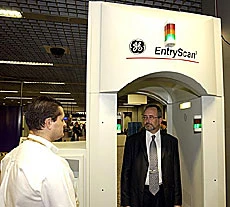
Similar to current metal detectors at airports, a person enters a security portal where a robot voice warns: “Air puffers on!”
Jets of air shoot out of the device, and dislodge microscopic particles from the person, which then sifts the particles for traces of explosives.
The average human body has a ‘heat signature’ equivalent to that of a 60-watt light bulb. Puffs of air dislodge body particles and the machine then provides a ‘convection plume’ to vacuum them and convey the particles up to a built-in laboratory where a sophisticated computer tests the molecular weights of the trapped particles.
As the puffers shut down, the robotic voice instructs the person to “Wait for green light.” Once the person is certified explosive free, the voice instructs the person: “Exit.”
The advantage to all this is that there’s no touching, no invasion to one’s privacy.
These ‘people puffers’ are already in place at secure, often classified facilities, including military bases, prisons and nuclear power plants both here and abroad.
Two machines seem most popular: One is the Entryscan, by General Electric which costs $40,000, and Sentinel II, by Smiths Detection & Protection Systems, part of a British conglomerate, which — with all the bells and whistles — can cost up to $150,000.
These devices make it possible to screen people with the most advanced explosives detection equipment available,” said Ken Wood, president of Barringer Instruments. “Given the reality of actual and potential suicide bombers, people must be screened thoroughly. The recent shoe bomber incident is just one example of the necessity to screen people using this technology.”
Both machines have a walk-through portal that is programmed to screen about seven people per minute for a variety of substances. Smith says it scans people in 9 seconds per person, whereas G.E. needs 15 seconds.
The Transportation Security Administration is currently testing the devices at various airports throughout the US.