JAKARTA, 10 September 2004 — Suspected Al-Qaeda-linked militants detonated a car bomb outside the Australian Embassy in Jakarta yesterday, killing nine people and wounding 160 in a devastating strike on a key US ally in the war in Iraq.
The bombing — the first attack linked to regional terror group Jemaah Islamiah in more than a year — could affect upcoming Australian elections, in which Prime Minister John Howard is running on a pro-American, anti-terror platform in a tight race.
No one inside the heavily fortified building was killed, although several Australian, Greek and Chinese citizens were wounded in the attack that occurred two days before the anniversary of the Sept. 11, 2001 strikes in the United States.
Jemaah Islamiah has also been blamed for the 2002 Bali bombings that killed 202 people, including 88 Australians, and an Aug. 5, 2003 suicide bombing at the JW Marriott hotel, located a few blocks from the site of Thursday’s blast.
Howard is facing criticism in the campaign over his decision to join Washington in the Iraq war, which his opponents say has made Australia more vulnerable to terror attacks.
“This is not a nation that is going to be intimidated by acts of terrorism,” Howard told reporters in Australia.
Analysts were divided on how the blasts would affect Australia’s Oct. 9 federal election. Howard is considered stronger on national security than his Labor challenger, Mark Latham — who has pledged to bring most of the Australian troops in Iraq home before Christmas — and may benefit from the perception that Australia is under attack.
The bomb exploded shortly after 10.15 a.m., just in front of the embassy’s gate, flattening a section of the steel fence and shattering scores of windows in high-rise office buildings up to 500 meters away. Police were investigating whether a suicide bomber triggered the blast, which sent thick smoke high into the air and could be heard up to eight km away.
“It was an enormous bomb, the enormity of the crater, the police truck outside has been blown to bits. It’s like the wind has been pushed out of you,” embassy media officer Elizabeth O’Neill told Australia’s Nine TV Network.
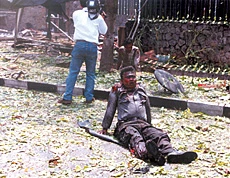
Bloodied victims lay sprawled and screaming in front of the embassy, as dazed survivors desperately tried to locate colleagues and missing family members. A severed leg, human scalp and torso were strewn on the street among mangled cars and motorbikes.
“I can’t find my family,” said one woman, Suharti, who had eight relatives working at the embassy. “I am terrified. I don’t know where they are.” Most of the nine dead were Indonesian policemen, embassy security guards and passers-by. The 160 injured were mainly office workers from nearby buildings, cut by flying shards of glass and debris, health officials said.
Speaking to reporters at the bomb site, national police chief Gen. Dai Bachtiar said the blast bore the hallmark of a Jemaah Islamiah operation.