
The chatter somewhere ahead of me rose and then fell occasionally into silence. It was difficult to locate its direction, as the palms and vegetation made it seem to come from the right and then from the left. Eventually I saw its source, a group sitting in the shade away from the shafts of strong sunlight penetrating the greenery.
The men wore either their loose white over shirt called a ‘dishdasha’ or a T-Shirt with an oblong piece of cloth, ‘wazar,’ wrapped around the waist. The women wore their everyday brightly patterned dress, trousers and scarf. The gathering at first seemed like a picnic with gossip and laughter. In fact, sitting in the shade of the date palms, these men and women were engaged in a more serious task. Their work was to separate thousands of dates from their stalks, a vital process in the annual date harvest of their oasis, Bidiyah, in the eastern region of the Sultanate of Oman. The workers and their families are modern day participants in the date harvest. The history goes back 6000 years to Eridu in lower Mesopotamia where the first evidence of date cultivation has been found. Closer to this oasis, the Hilli settlements of Al Ain in the Arabian Peninsula seems to have cultivated dates some 5000 years ago.
The export of dates was a mainstay of the Omani economy before the discovery of oil. The fruit was shipped around the world. One hundred years ago, the USA imported 2800 tons of dates and India 15,200 tons, accounting for 35percent of all exports by value through Muscat. Today though the USA has its own date orchards, India still likes Oman’s dates, importing 8,390 tons in 2000. Most of the dates exported to India are processed into a finished product called ‘busur’ and the people I met were harvesting the date named Mubselli that provides India’s ‘busur.’
In Bidiyah with its date orchards, dates are a mainstay of the economy. The Omani Ministry of Agriculture reports that there are some 100,000 date palms in Bidiyah. A substantial proportion of these are Mubselli which can yield up to 55 kilos of dates per tree. Like most date orchards in Oman, that of Obaid Masoud Al-Hajri is not large — only 83 trees.
The income from the dates, however, provide him and his family with a good-sized chunk of their annual income.
Date growing is labor intensive in Oman and very traditional in its methods. The first stirring in this lengthy process is the auction of the males spathes (the bract and flowers of the male date palm) locally called ‘tal-la’ in the ‘souqs’ (markets) throughout Oman in January.
These ‘tal-la’ vary in length between depending on the variety. Since the date palm is either male or female, the farmer prefers to grow female ones since they produce the dates. He then relies on these auctions for his supply of male flowers.
With prices around $10, the ‘tal-la’ are not expensive but the farmers do not let a low price blind them to unsuitable quality. Each ‘tal-la’ is carefully inspected to ensure the variety is the desired one and the pollen (which in Oman is called ‘nabat’) is smelt to make certain it is free of disease and of good quality. Following its purchase the ‘tal-la’ undergoes a brief period of drying which ensures that the ‘nabat’ will spread more readily during the pollination process. The pollination itself is the start of the farmers’ hard work to bring the fruit to market. To fertilize the female flowers (pistils) each date palm, called ‘nakhl’ throughout the Arab world, must be climbed and the pistils, which are clustered in the center of the leaves, pollinated. Each date palm provides the farmer with natural steps to climb the trunk. These are formed from the base of the previous season’s leaf stalks which were cut off. The technique of climbing is simple but since a date palm can be 30 meters tall, a key requirement is a good head for heights. Using a harness called “haboul at tuloo” around both him and the tree trunk, the farmer climbs up to reach the crown of leaves in the center of which the pistils are found.
In the farms of Bidiyah, where the women are so diligent in their task, Obaid explained that the farmers normally use a direct application from the male flower (stamen) and leave a small spike of the stamen inserted into the pistil. This application of the ‘nabat’ needs to be timed to coincide with a specific phase of the pistil’s development in order to ensure maximum fruit; otherwise, Obaid says, there will be few fruits that mature.
As the date fruit grows, it looks much like a small green pea growing on a stalk. The dates grow gradually until their weight causes the stalk to bend. To support this weight, another climb up the tree is undertaken. This time the whole bunch is positioned so that its weight rests on the base of a leaf stalk and gives the crown of the date palm its characteristic appearance of wearing a heavy necklace. It must be one of the most remarkable ironies about nature’s bounty that the work required to reap the benefit of the date must be carried out in June when the shade temperature in Oman may reach 50 C. and the cicadas, so common in Oman, work overtime as their humming increases with temperature.
Obaid told me of an Arab saying “A ‘nakhl’ needs its feet in water and its head in fire.” The maturing of the fruit depends on a regular supply of water as well as the high summer temperatures of the Arabian peninsula. When he saw that I fully understood the fire part of the story, he took me to see the water. The man-made canal or ‘falaj’ in Bidiyah provides the water supply for the dates in the oasis. The ‘falaj’ system in Oman goes back into ancient history, possibly being developed over 4000 years ago. This consistent source of water may have enabled the nakhl to be cultivated more widely in Oman than before the ‘falaj’ was developed. Here in Bidiyah the ‘falaj’ runs underground for almost 10 kilometers, collecting the water from the underground water table and bringing it into the oasis where it becomes a small surface system that waters each of the small fields there.
The ‘nakhl’ which had been so arduously climbed earlier in the season is again climbed by a man in order to obtain the fruit that is now ready for harvest. Either the whole stalk is cut off and tied to a rope to be lowered to the ground or each date is individually plucked while the man is at the top of the palm.
The women I met in Bidiyah during my visit were engaged in dealing with the complete bunches of the Mubselli variety of date so that it could be processed prior to shipment to India or sold in a local ‘souq.’ Just when I had begun to think that I had adjusted to the day’s heat, Said Salim Al Amri, who had a farm near Obaid’s then took me to observe the next step in the operation.
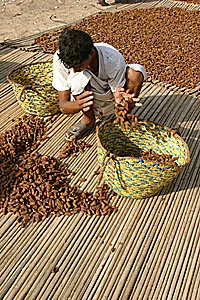
Bubbling away were two vast pans filled with water from the ‘falaj’ and the Mubselli dates. Under the pans, a furnace was being refueled with leaves from the ‘nakhl’ and the discarded date stalks. This whole cooking range is called a ‘terkabah’ and its function is to boil Mubselli dates. As in much cooking, the dates were stirred occasionally until, the chef decided they had been boiled to perfection. Said explained that normally this takes about an hour. With a sieve big enough for a giant, the dates were ladled out of the water and transported to mats or ‘da’an’ made of the dried leaf stalks of the ‘nakhl.’ Here Said carefully spread the dates so that they could dry in the heat of the sun which, despite its intensity in Oman, takes as much as three days. This method of processing is only used for the Mubselli variety of date in Oman — the combination of boiling and sun-drying makes the date last longer when it is stored.
The new shriveled appearance was not all that was new in the date; it also gained its new name ‘busur’ and under this name, it is taken to Muscat and shipped to India. There it is an essential part of the cuisine of festivals, celebrations and weddings.
My final glimpse into the journey of the Mubselli date came not in India but back at the souq. Here the dried dates were being inspected, bargained over and finally bought in much the same way as the ‘tal-la’ had been at the start of the process some 6 months earlier.