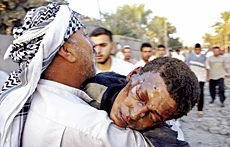
BAGHDAD, 26 September 2004 — US jets pounded Fallujah yesterday, killing seven Iraqis in a raid the military said targeted a hide-out of a militant group led by Abu Mussab Al-Zarqawi.
However, medics in the town said women and children were among the dead. Residents said another strike on the town was under way later.
Another seven Iraqis — National Guard recruits — died in a rebel attack near the capital, Baghdad, while a roadside bomb killed a US soldier in the area, bringing to five the number of US troops killed in 48 hours, the military said.
In New York, visiting Iraqi Prime Minister Iyad Allawi pledged that Iraq’s own forces would secure the country in time for January elections to be held.
In the shadowy and bloody battle involving foreign hostages, Britain sent a delegation from the Muslim Council of Britain (MCB) to seek the release of engineer Kenneth Bigley, threatened with the same death, by beheading, meted out earlier this week to two Americans kidnapped with him.
Bigley, 62, and the Americans were seized from their Baghdad home this month by the Unity and Holy War group of Zarqawi.
A website claimed yesterday that he had been executed but the British authorities dismissed the statement.
Prime Minister Tony Blair vowed to do whatever he can to secure the release of Bigley
“We’ll continue to do all we can for Ken Bigley,” Blair said. “We have been in touch with the Bigley family and I think everyone is amazed at how dignified they have been over the last few days.”
The engineer’s family continued to issue desperate pleas for his life as did the families of six Egyptians kidnapped recently, although no group has yet claimed responsibility for kidnapping the men, all employed by the Egyptian telecom giant Orascom.
“This leads us to estimate that there are no political motivations behind these kidnappings,” an Egyptian diplomat in Baghdad said.
The fate of two missing Italian women, both aid workers, remained unknown, despite two claims that they had been killed.
An Italian daily yesterday published around 40 grisly pictures of beheadings of hostages in Iraq and Pakistan, riding roughshod over the feelings of families and friends of the two young aid workers, Simona Torretta and Simona Pari.
Il Foglio said the move was “to protest against the indifference, passivity, ignorance and submission with which the politicians and the media, above all in Italy, are facing up to the religious war and the clash of civilizations going on in the world.”
In its daily battle against insurgents, the US military said its air force “conducted a strike inflicting a blow to the Zarqawi terrorist network by conducting a precision strike on a known terrorist meeting site in central Fallujah.”
The military also disclosed the deaths of the five soldiers, one yesterday in the Baghdad area by a roadside bomb, and four Marines in three separate incidents on Friday in Al-Anbar province, which includes Fallujah.
Besides the Baghdad attack on National Guard recruits in which seven Iraqis died, insurgents in the restive town of Baqubah, north of Baghdad, killed a police officer.
At least one rocket and three mortar rounds struck Iraq’s heavily fortified Oil Ministry building in Baghdad, causing some damage but no casualties.
Meanwhile, on a trip to the United States, the Iraqi premier assured the US administration that his forces could secure the country but demanded broader participation from the international community.
“I appeal to all representatives from the countries gathered here to help Iraq defeat the forces of terrorism and help Iraq build a better future for the people of Iraq,” Allawi told the UN General Assembly.
US Secretary of State Colin Powell, meanwhile, told the New York Times Allawi wanted to organize a conference including G-8 and Middle Eastern countries in October to boost Iraq’s electoral process.
Allawi insisted elections would go ahead as planned, but even US Defense Secretary Donald Rumsfeld acknowledged that the vote might have to exclude no-go zones like Fallujah. Democratic presidential candidate John Kerry, who has been stepping up his attacks against the US administration’s handling of the war in Iraq, on Friday charged Allawi with turning a blind eye to reality in his country.
US President George W. Bush, who had earlier welcomed Allawi to the White House to help spread his optimistic view of Iraq’s future, responded: “You can’t lead this country if your ally in Iraq feels like you question his credibility.”
Later, in his weekly radio address, Bush said: “The war for Iraq’s freedom is a fight against some of the most ruthless and brutal men on Earth.
“In such a struggle, there will be good days and there will be difficult days. But every day, our resolve must remain the same.”
— Additional input from agencies