BAGHDAD, 2 October 2004 — US forces launched a major offensive into the heart of one of Iraq’s key insurgency strongholds yesterday to regain control of areas lost to the rebels. More than 100 Iraqis were killed and 37 captured in the attack on Samarra, an Iraqi minister said.
Backed by warplanes and tanks, some 5,000 troops swept in to seize the city hall, the main mosque and other key sites, leaving only pockets of rebel resistance after more than 12 hours of combat, according to the US military and Iraqi authorities.
The attack against Samarra, 95 kilometers north of Baghdad, appeared to trumpet the launch of major military operations to wrest other areas of the country from insurgents ahead of general elections in January. It is feared that inability to stage balloting in cities such as Samarra would severely mar, or even invalidate, election results.
Also yesterday, US warplanes and tanks attacked the vast Baghdad slum of Sadr City, killing 12 Iraqis and wounding 11 others, a hospital director said. The military said only one armed rebel was killed.
“We will spare no effort to clean all the Iraqi lands and cities from these criminals and we will pave the way through these operations not only for the reconstruction but also for the general elections,” Qasim Dowoud, minister of state for national security, told a news conference.
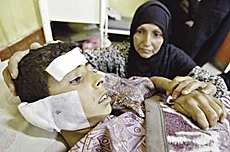
Dr. Khalid Ahmed said at least 80 bodies and more than 100 wounded were brought to Samarra General Hospital, but it was not immediately clear how many were insurgents.
Dowoud said more than 100 insurgents were killed in the fighting and 37 others captured, including members of the fallen Saddam Hussein regime. No foreign Arab fighters were taken captive, he said.
One American soldier was killed and four were wounded, while an AH-64 Cobra helicopter was hit by small arms fire but was able to land safely at a coalition base near Samarra, the US military said.
The operation involved about 3,000 soldiers of the US 1st Infantry Division along with 2,000 members of the Iraqi Army and Iraqi National Guard.
“We are working on the complete clean-up of the city from all those terrorists,” Dowoud said, describing Samarra as an “outlaw city” that had spun out of control.
Smoke rose from an area around the Imam Ali Al-Hadi and Imam Hassan Al-Askari Mosque. But the mosque was not damaged and an Iraqi commando unit took the mosque, capturing 25 armed insurgents, said Maj. Neal O’Brien, a spokesman for the 1st Infantry Division.
“Coalition forces and Iraqi security forces will do everything possible to protect the valuable site from damage,” he said.
The situation in Samarra, a city of 250,000 people, appeared calm late yesterday except for American snipers on rooftops firing at anybody appearing in the streets below.
Some residents of the city had fled before the attack, but most stayed behind amid news of intense negotiations to solve the crisis peacefully.
The assault began shortly after midnight. Residents cowered in their homes as tanks and warplanes pounded the city. Loud explosions and the crackle of automatic gunfire continued sporadically into the afternoon. Houses were flattened and cars charred.
“We are terrified by the violent approach used by the Americans to subdue the city,” said Mahmoud Saleh, a 33-year-old civil servant. “I hope that the fighting ends as soon as possible.” US and Iraqi forces blocked the roads into the city to prevent insurgents moving in and out, O’Brien said.
As Iraqi forces secured the Samarra bridge, American soldiers saw insurgents in speedboats loading ordnance on the banks of the Tigris River, the military said. Soldiers fired warning shots and the insurgents returned fire, prompting US forces to destroy the boats, killing their occupants, a statement said.
Water and electricity services were cut off, and troops ordered residents to stay off the streets as they moved from house to house in search of insurgents. A 7 p.m.-to-7 a.m. curfew was announced. The offensive came in response to “repeated and unprovoked attacks by anti-Iraqi forces” against Iraqi and coalition forces, the military said.
— Additional input from agencies