
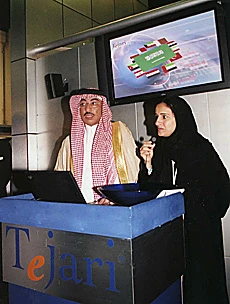
Tejari (www.tejari.com), the Middle East online marketplace, has launched Tejari Saudi Arabia as part of its ongoing regional expansion strategy. The move into the region’s largest market signals the e-procurement service provider’s confidence in the growing acceptance of online business in the region.
Tejari’s entry into Saudi Arabia is being carried out in partnership with the Al-Ghabban Group, a leading group of companies specializing in construction and property management, with operations in Kuwait, Iraq, Saudi Arabia, Bahrain, Djibouti, and Qatar. Tejari Saudi Arabia is the third project on which Tejari and the Al-Ghabban Group are collaborating — the two organizations announced their franchise agreement for Tejari Iraq in November 2003 and Tejari Kuwait in January 2004.
“Tejari now has reached the operational maturity and critical mass of trading partners necessary to enter the Saudi Arabian market, the largest in the Middle East for e-business and e-government services, as well as related Internet hardware and software. Experts estimate that at present, more than $6 billion is being invested in communications infrastructure in the Kingdom,” said Sultan Bin Sulayem, executive chairman, Dubai Ports, Customs and Free Zone Authority, and chairman of Tejari.
“The Saudi government has already undertaken significant steps to incorporate e-government into its services. It is now Tejari’s job to communicate effectively to both the public and private sectors in the Kingdom the numerous advantages of e-procurement, including the reduction in paper-based tasks, faster time to market, enhanced customer awareness and increased profitability,” added Bin Sulayem.
Prior to finalizing their franchise agreement, Tejari and the Al-Ghabban Group conducted intensive feasibility studies on the potential for online procurement in the Saudi market.
“Middle East businesses are proving increasingly receptive to the online procurement model and Tejari itself — especially once they take into consideration the cost-savings and improved efficiency that this business process delivers. As we have seen recently in Kuwait and Iraq, the combination of Tejari’s e-procurement model and the expertise and experience of the Al-Ghabban Group is set to significantly change the way that Saudi Arabia ’s business community buys its goods and services,” said Mohammad Al-Ghabban, chairman, Al-Ghabban Group.
“The IT-enabled business revolution currently sweeping the Middle East is nowhere more evident than in Saudi Arabia, where ambitious plans from both the government and private sectors are creating more demand for successful, regionally-based online initiatives such as Tejari. The right infrastructure for e-governance exists in the Kingdom and it is incumbent on Tejari to capitalize on this effort and work towards encouraging wider use of e-services.”
Officials from Tejari and the Al-Ghabban group have estimated that the industry sectors in Saudi Arabia most likely to adopt the online procurement model are construction, banking, government and technology.
Commenting on the company’s entry into the Saudi market, Sheikha Lubna Al Qasimi, Tejari’s CEO, said: “Tejari has been at the forefront of e-business and online procurement in the region for the past four years and entering Saudi Arabia has been among our top priorities. Our objectives in the Kingdom will focus on delivering more key information and trading opportunities for local businesses while creating new services and areas of market reach to serve their interests.”
In discussing key points concerning Tejari’s move into Saudi Arabia, Sheikha Lubna explained that the company had wanted to wait until the time was right and that the trend toward online transactions and business activities had been established to some extent.
“We did not want to go into the Saudi market as the first ones, promoting the concept of the online marketplace,” she said. “We are fortunate to be doing this with Al-Ghabban because they have already demonstrated to us success stories in Iraq and Kuwait where they hold the Tejari franchises. Between those two operations they’ve rolled out quite a lot of transactions. Huge companies in Kuwait have joined Tejari’s marketplace. Al-Ghabban have been firmly established in business for the last twenty years. They have a lot of their own business and logistics. Al-Ghabban Group has a lot of different operations including manufacturing. So they have a lot of their own transactions to move online. Basically, Mohammad Al-Ghabban is a quiet man who is doing a lot of business. We are pleased that Tejari is helping to facilitate that business and we have a great relationship with him through our two other franchises.”
Sheikha Lubna asserted that while initially construction, banking, government and technology will be the focus of Tejari Saudi Arabia, this does not mean the company has no plans for other business sectors in the Kingdom.
“When you look at the market within Saudi Arabia, you can look at it within three different tiers. There is basically the government environment, the large industries and then you look at the small and medium-sized companies, which make up the majority of companies in Saudi Arabia,” the Tejari CEO said. “For us the large enterprises are on the map but we want to emphasize that we can serve others. It’s not like we are not going to work with large enterprises, but the small and medium-sized companies are equally important to us. I think Saudi Aramco has been the leader in pushing the B2B payment gateway. In fact, they have been the leader in the whole region to do that. We have had dialogue with them before and respect them and do plan to work with them as the opportunities arise.”
The awarding of the Tejari franchise for Saudi Arabia is just one aspect of the company’s push to accelerate its expansion across the region.
“Tejari and our franchise partners are connecting the region in a way which has never been seen before,” said Neil Le Quesne, director, International Business, Tejari. “The entire region has entered a new era of openness and competitiveness with Tejari providing the tools required to operate in this connected regional environment. In parallel to working toward the completion of our Middle Eastern rollout, we are increasingly turning our attention to Africa and the Subcontinent — we expect to make announcements on these developments soon.”