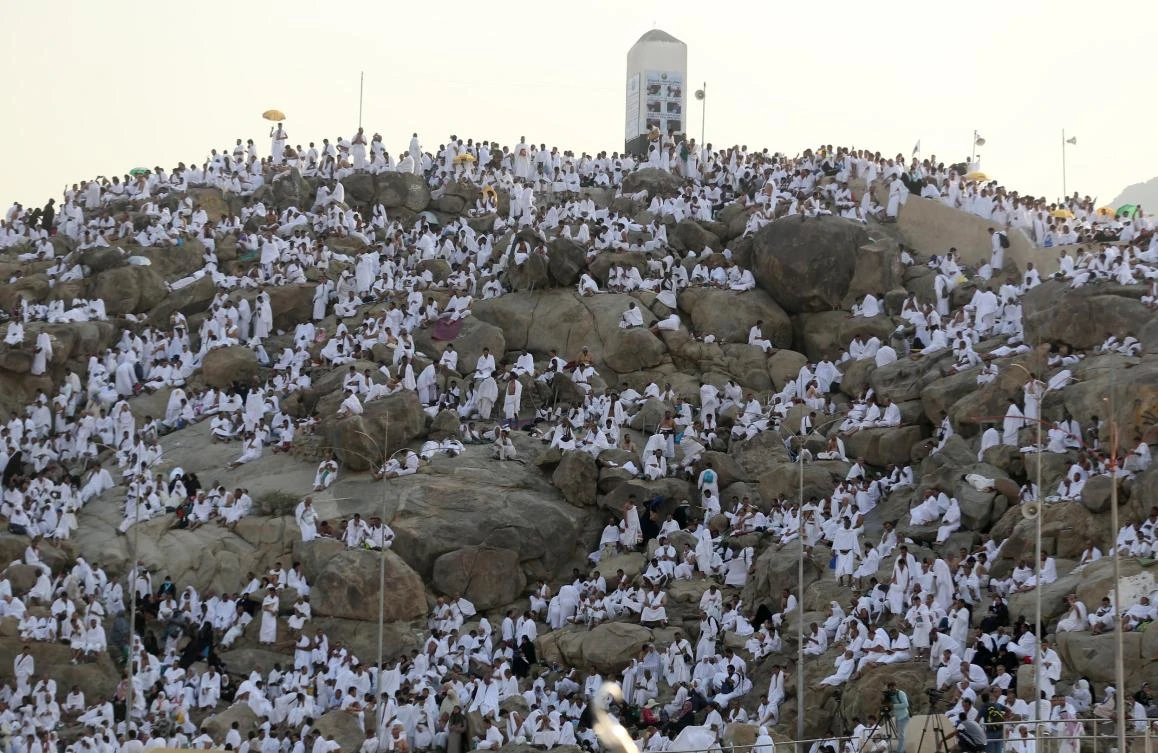
JEDDAH, 26 October 2004 — Many Umrah visitors who arrive during Ramadan do not return until after Haj. They find it a good opportunity to kill two birds with one stone by coming for Umrah and staying on to perform Haj as well and in the process save a lot of money.
If the visa runs out in the meantime it is another matter.
Every year, millions of pilgrims arrive in Saudi Arabia for Umrah and Haj. Half of them leave after performing the pilgrimage while the rest stay back in the Kingdom in search of jobs. Umrah companies, in conjunction with the Haj Ministry, takes a caution deposit from each pilgrim who arrives in the Kingdom. If the pilgrim leaves the country, the money will be returned.
Umrah companies are held accountable if pilgrims do not leave on time. The companies hold the money as insurance when the pilgrim arrives and pays the money as fine to the Haj Ministry if the pilgrim breaks the law and stays back even after his visa has expired.
Muhammad Barakat, an Egyptian pilgrim from Cairo, said, “This is the second time I came for umrah. The first time was three years ago. I did not have the chance to perform Haj and with God’s will, I will be able to perform Haj this season. It is very difficult for people in our situation to go back to Egypt and come again for Haj. I decided to stay because many people advised me that this is the best way to perform Haj in the given circumstances. Millions of people in Egypt want to perform Haj and most cannot afford it.”
“I understand that a quota is fixed for each country and only a certain number of people are allowed in every year and my chance to be in the Haj list from my country is slim. What motivates me to stay back for Haj is that many of my countrymen living here have offered to give me money and shelter. Some even offered me work to support myself for the two months of my stay and help to avoid being caught.”
Another Umrah pilgrim from Pakistan said, “If staying until Haj means that I would become an overstayer then so be it. The most important thing for me is to perform Haj at all cost. It took me years to collect the money so I would be able to come here. Every time I apply for Haj visa I get denied because of the ceiling on the number of incoming pilgrims. Since I got the opportunity of coming for Umrah and Haj is only two and a half month away, then why not stay and perform Haj and get it over with? I understand that by doing that I am violating the law but I cannot afford to leave and come back again.”
Local Saudis sympathize with Umrah pilgrims and have mixed reactions about their tendency to overstay. Ateeq Al-Harbi, a Saudi taxi driver from Makkah, said, “I can tell you that more than half of the people in Makkah are overstayers. In one way I sympathize with them. They are violating the Saudi law. At the same time when you listen to their stories and understand their financial situation, you tend to help them. These visitors have come from distant countries and from very poor background. They dream of performing the Haj before returning home. To me, they are not criminals or violators; they are victims of a tough law. As a Saudi, I cannot harbor them because I do not want to violate my country’s law. However, I advise them on how to avoid being caught by the passport department. In some cases, I offer them financial help when they are short of money. After Haj, it becomes a different story and they will be looked at as overstayers and I will report them to the passport department if I have to.”
Dhafer Al-Zahrani said, “Overstayers are overstayers and they violate the law. I will report them to the passport department when I see them because we only get trouble from them. Every country has the right to write its own law. Saudi Arabia describes people with expired visas as overstayers who should leave the country if caught. It is not fair if, let us say, 200,000 people come from country X for Umrah and only 150,000 leave the country. If there were overstayers from every country waiting for Haj, then we would have an extra of half a million of pilgrims in addition to the ones arriving for Haj. This is unfair and Saudi Arabia has every right to arrest them and deport them for the sake of pilgrims coming for Haj.”
Muhammad Al-Shenqiti said, “I know it is against the law to harbor overstayers. Sometimes relatives from my tribe from Mauritania come for Umrah and want to stay until they perform Haj. Under our unwritten cultural law, I cannot kick them out or report them to the passport department. Because they are from my tribe I am forced to provide them with housing and food until Haj. It is a difficult situation... because if I have to apply one law, I have to break another. I do my best to keep them hidden until Haj. I avoid taking them out unless it is very necessary. Also I am looking for reward from God since I am doing something good helping these relatives to perform Haj. I think people like these should be left alone if they are not causing any trouble and they are not searching for work.”
A source at the passport department said that such people are violating the law and they will be punished if caught. “People harboring overstayers with expired visa will face punishment. If the overstayer is harbored by a foreign resident, then the violator will be fined SR10,000 or one month in jail or both. If the violator is a Saudi then he will face an SR10,000 fine plus two weeks in jail in the first instance. If he repeats the crime, the punishment is doubled. If caught for the third time, the sentence will be SR30,000 fine and three months jail.
The Umrah agency which brought the overstaying pilgrim would face financial penalty and if the violation is repeated, the agency would face closure. As for overstayers themselves, they would face imprisonment, fine and deportation. They would be deported only after paying the fine.