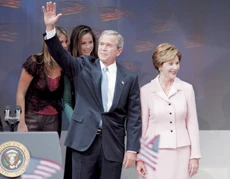
WASHINGTON, 4 November 2004 — President George W. Bush won a second term in the White House yesterday from a divided and concerned nation and pledged to “fight this war on terror with every resource of our national power.” John Kerry conceded defeat rather than back an election challenge in make-or-break Ohio.
“I will need your support and I will work to earn it,” the president said in an appeal to the 55 million Americans who voted for his Democratic rival. “We are entering a season of hope,” he said.
The president spoke before thousands of cheering supporters less than an hour after his vanquished rival conceded defeat. “We cannot win this election,” the Massachusetts senator said in an emotional campaign farewell in Boston.
Custodian of the Two Holy Mosques King Fahd, Crown Prince Abdullah, and Prince Sultan, second deputy premier and minister of defense and aviation, yesterday sent messages of congratulations to Bush on his re-election.
In his message, King Fahd reaffirmed his desire to work with the president to strengthen the historic relations between the two countries as well as to resolve outstanding international issues to reinforce world peace and security.
“I am looking forward to continue the strong cooperation with you and your administration to bolster the friendly relations between our governments and peoples in political, economic and commercial and other areas,” Prince Abdullah said and pledged Saudi Arabia’s support to US efforts to find a just and lasting solution to the Palestinian issue, fight terrorism and bring about peace and security in Iraq.
The re-election triumph gave the president a new term to pursue the war in Iraq and a conservative, tax-cutting agenda at home — and probably the chance to name one or more justices to an aging Supreme Court.
He also will preside alongside expanded Republican majorities in Congress. The GOP gained four Senate seats and bolstered its majority in the House by at least two.
Bush sketched only the barest outline of a second term agenda, talking of reforming an “outdated tax code,” overhauling Social Security and upholding the “deepest values of family and faith.”
Hours earlier, Kerry had telephoned Bush to offer a private concession. Aides to both men stressed they had agreed on a need to heal the nation after a long and frequently bitter campaign.
Ohio’s 20 electoral votes gave Bush 274, four more than the 270 needed for victory. Kerry had 252 electoral votes, with Iowa (7) and New Mexico (5) unsettled.
Bush was winning 51 percent of the popular vote to 48 percent for his rival. He led by more than 3 million ballots.
Officials in both camps described the telephone conversation between two campaign warriors.
A Democratic source said Bush called Kerry a worthy, tough and honorable opponent. Kerry told Bush the country was too divided, and Bush agreed, the source said.
Yet Kerry’s public remarks contained an element of challenge to the Republican president.
“America is in need of unity and longing for a larger measure of compassion,” he said. “I hope President Bush will advance those values in the coming years.”
Kerry placed his call after weighing unattractive options overnight. With Bush holding fast to a six-figure lead, Kerry could give up or trigger a struggle that would have stirred memories of the bitter recount in Florida that propelled Bush to the White House in 2000.
Kerry’s call was the last bit of drama in a campaign full of it. While Bush remains in the White House, Kerry returns to the Senate, part of the shrunken Democratic minority.
He acted, hours after White House chief of staff Andy Card declared Bush the winner and White House aides said the president was giving Kerry time to consider his next step.
One senior Democrat familiar with the discussions in Boston said Kerry’s running mate, North Carolina Sen. John Edwards, was suggesting that he shouldn’t concede.
— Additional input from agencies