“People robbed of their past seem to make
the most fervent picture takers”
Susan Sontag, On Photography, 1977
Palestinian photographer Ahmed Jadallah was born in Gaza in 1970. He studied Science and Public Relations and Media. He worked as a cameraman for CBS and since 1992 he has joined Reuters and is now Senior Photographer in Gaza.
Ahmed Jadallah’s work has been exhibited in Gaza, Egypt, Norway and France. His pictures have recently been displayed in the British Parliament and are currently presented in Amsterdam at the Noorderlicht Photography Festival.
He has worked as a reporter, cameraman and photojournalist taking over ten thousand photographs of life in the Gaza Strip for Reuters. Almost daily he shoots reportages of Palestinian funerals and Israeli violence. His powerful images — in which women and children take centerstage — show scenes of the horrors and brutality of war.
A combat photographer, Ahmed Jadallah believes that it is his mission to bear witness and make the world see the despair of the Palestinian people. Despite multiple injuries and Israeli restrictions on his movements, he continues to photograph in Gaza, putting his life in danger on a daily basis; focusing his camera on Israeli violence and its effect on the Palestinian people in powerful and intimate close detail.
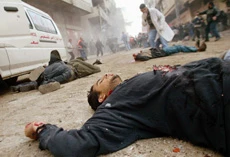
In 2003, Ahmed Jadallah was hospitalized in critical condition during the Israeli shelling of the Jabalya Palestinian refugee camp in which 13 Palestinians were killed and several hundreds more wounded. Jadallah nearly lost his legs after a tank shell had smashed both his legs, killing eight people around him. He responded with spontaneity and took a close-up photo of a bomb blast victim just before he himself passed out. Despite a number of operations his health is not completely restored and he is still recovering from his wounds.
It is clearly no easy task for journalists operating in war-ravaged countries. Denise Leith, in her book, Bearing Witness: The lives of war correspondents and photojournalists (Random House, Australia), points out that journalists suffer post traumatic stress and find that settling back home is not always easy. She recounts that a British journalist left Rwanda in 1994 and within hours found himself at a Wimbledon tea party. He could not answer when asked what he had been doing. “These two realities could not meld,” he said. On the other hand, there are those who do not want to live the retelling of their experiences, writes Denise Leith. They want to escape from the trauma that they see as “part of the cost of doing this really important job”.
Ahmed Jadallah amassed photojournalism awards. In 2001, he was named the best photojournalist of the Year by the Arab Journalism Awards in Dubai. He was unable to collect the prize because of an Israeli travel ban preventing him from leaving the Gaza Strip.
Earlier this year, he won the 1st prize in the Spot News category of the prestigious World Press Photo Contest. World Press Photo is an independent, non profit, cultural organization, founded in The Netherlands in 1955. Its main aim is to support and promote internationally the work of professional press photographers. Every year, the Amsterdam-based foundation invites press photographers and photojournalists throughout the world to participate in the World Press Photo Contest.
If we consider photography as the inscription of the present and as a visual narrative, its potential as a medium becomes even more important when it is used as a tool to convey the truth – a truth that many would rather keep silenced.