
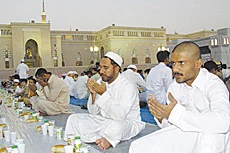
Breaking one’s fast outside the holy mosque in Madinah is a moving experience. Residents of Madinah and many pilgrims break their fast outside the mosque; for them, iftar there is a unique experience, especially in Ramadan. People describe the gathering outside and inside the mosque as the brotherhood meeting. People smile at each other, shake hands with strangers from different backgrounds and countries who speak a variety of languages. They all come together to break their fast. Zamzam water, dates and pastries are shared among them.
As the sun sets, casting its last rays of light upon the holy mosque, people wait for the call to prayer, hoping that God will accept their fast. Visitors to the holy mosque will not miss the chance of breaking their fast at the place which many people call their home away from home. There are tens of thousands of people sitting inside and outside the holy mosque waiting for iftar. Minutes before maghreb, people begin to share the food they have brought with them. It does not matter if someone came to the mosque without food.
Everyone makes sure that everyone else has plenty to eat.
The variety of cultures and nationalities are represented in the range of food available at the meal. When the call to prayer sounds, people begin eating dates and drinking water. Everyone shares his or her food with those near them. People do not always eat the food they brought from home because they want as many fasting people to eat it which means rewards from God. Abdul Aziz Jumah, a Pakistani, said, “I have never missed iftar in the holy mosque for seven years. Everyday I buy what is necessary for iftar, make my own place and invite many people to sit with me. I take my brothers and children with me to help me. I begin an hour before iftar and I cannot describe how happy I am to be in this place with thousands of my brothers. Sometimes I wonder, why people break their fast at home instead of coming to the mosque.
Hasan Basheer, a pilgrim from Sudan, said: “I make sure that I come to the holy mosque every day for Asr prayer. After praying, I devote my time to reading the Qur’an or listening to one of the sheikhs until Maghreb. Breaking iftar outside the holy mosque is unique. I cannot describe it because you have to taste it yourself. The feeling just cannot be described. Tens of thousands of people around you are fasting. We share the same food. All seek God’s forgiveness and pray that their fasting is accepted. What I like about iftar here is that I develop friendship with people whom I have met for the first time. Every day, I get to know people who share food with me on the plastic food spread. During and after iftar we talk about our problems and crises facing the Muslim world. It is with fond memories that I will return to Sudan. Ramadan in Madinah, especially outside the holy mosque, is the best Ramadan that I’ve ever had”.
Mahmoud Hanafi, a pilgrim from Egypt, said: “Breaking iftar outside the holy mosque is very much similar to having iftar in Egypt; the only difference is that is the sanctity of this place and, also I get to meet a lot of people from different background and nationalities. The scene of people gathering outside the holy mosque is a beautiful, enduring scene. Some of them are reading the Qur’an, some are seeking Du’a and some simply enjoy in tranquility the movement of the crowd or just some seated groups waiting to break their fast. Breaking iftar outside home is a must. People of Madinah who do not come to the holy mosque for iftar are missing all the fun.”
Musallam Al-Saiedi, a local resident, said: “Despite the many invitations I get from family relatives to join them for iftar, I tell them that I am occupied or have been invited by friends. My friends are the people breaking their fast outside the holy mosque. It is an honor for me to bring the food cooked by my family to the holy mosque and serve it to the visitors and pilgrims. We have an expression in Arabic ‘the master of the people is the one who serves them’. When prayer call is made, I make sure that the people sitting with me have something to eat and drink. My heart wells over when I see them breaking their fast and raising their hands in supplication to God.”
Soon after the fast is broken the seemingly long spreads of plastic just disappear in less than 2 minutes in an organized way before the Maghreb prayer starts. The system is simple. At every food table, there are two people responsible for collecting the plastic spreads, with the remnants of the food in it, placing it in specially designed bags before disposing it off in garbage containers.
The transformation from thousands of plastic spreads to a place ready for prayer in less than three minutes, is unbelievable.