
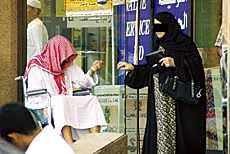
JEDDAH, 22 November 2004 — Mustafa gave me some good advice as we sat across from one another begging outside a supermarket on Sary Street a few days before the end of Ramadan.
Mustafa is a full-time beggar who prefers to work the supermarkets. On this particular day, he was positioned in his wheelchair just outside Al-Raya. I watched him from far away as shopper after shopper passed him handing over some, if not all, of their change from their grocery purchases.
I had just spent the last hour at the Danube Supermarket on Tahlia dressed in pajamas, caked with dirt, soda and strawberry jam trying to gain people’s sympathy by posing as a beggar. I was having a very difficult time with it. At first I tried washing car windows, but that only irked the drivers who consistently shooed me away. Failing that, I tried being aggressive and persistent. All that got me was a few nasty looks and some sharp words as one woman shouted, “Why? Why should I give you money? What’s wrong with you? You can’t work? Why should I give you money that my husband worked for?”
Nothing was working — no one was giving me their money. Out of desperation and ignoring the demands from store security to go away, I decided to make a last-ditch desperate attempt at making some money. I went inside the Danube Supermarket to the iftar dinner buffet counter. There were several men and women gathered around the counter picking out and paying for their iftar plates. I approached each one of them as the men and women were being handed their food plates and change and asked them for help. Again, I was ignored by all but security who asked me to leave the store and not return again.
Thinking that the problem was perhaps my location, I decide to make my way over to Al-Raya Supermarket on Sary Street. There again, I had no luck as I tried for 45 minutes to get even a single riyal. It was there that I saw Mustafa, an Egyptian man who was seated in a wheelchair. He seemed to be having all the luck in the begging world as person after person coming out of the store handed him their change. Mustafa was in an old, worn-out thobe. It was lifted and positioned in a manner that revealed a slight swelling in his leg along with the early onset of varicose veins.
Wanting a little bit of the action for myself, I decided to go sit on the curb near him so that I would be between him and the exit doors. The idea was for people to see me first and give me their money instead of Mustafa.
As I took my place near him, the transformation that took place in front of my eyes was unbelievable. This seemingly crippled, misfortunate poor man, seated in a wheelchair, suddenly sat up, and said rather menacingly, “Can’t you see that I am working here? Go somewhere else.”
“I’ve been on my feet for an hour and have not pulled in a single riyal,” I explained to him. “I have tried washing car windows. I have tried sitting silently with my hand outstretched. I have tried being pushy, aggressive and insistent. As a matter of fact, I even went inside the Danube Supermarket and walked up to people as they paid for their hot iftar plates and asked them for money No one would give me anything,” I continued.
“It’s not my problem, go away,” Mustafa told me.
Somewhat irritated that he was making more money than I was, I told him I wouldn’t go away until someone gave me money. It was an hour before iftar, and the supermarket was packed. I was determined not to leave until I had at least one riyal in my pocket.
Seemingly frustrated at me, he said: “No one is going to give you any money; you just don’t look pitiful enough. You have all your limbs. You’re tall, broad-shouldered and look healthy. There is nothing wrong with you apart from your dirty clothes. People aren’t going to feel any sympathy for you.” It made total sense to me as I walked back to Arab News support team seated in a parked car nearby, ready to help in the event I was arrested by the anti-beggary squad.
I went back to Arab News with nothing to report. It seemed that this investigation was doomed to fail. I had been growing a beard for nearly a month, and, despite my best efforts that included not showering for a couple of days, Mustafa told me I didn’t look pathetic enough.
It made perfect sense. The following day, I borrowed a great aunt’s wheelchair and went to buy a very short thobe. When I brought the thobe home, it was immediately sprayed with a little bit of water and dragged across the roof of my building, gathering as much dirt and dust as possible. I dirtied my feet with some mud and grabbed an old ghutra out of the laundry basket. According to my friends, neighbors and colleagues, the transformation was amazing — and it seemed to work.
Again I made my way over to Al-Raya Supermarket to speak with Mustafa. When he saw the wheelchair and the outfit, he was angry, yet amused. After some small talk, he told me to move on in no uncertain terms. I was a little doubtful of his claim to be wheelchair-ridden and didn’t want to take a chance that he would get out of his wheelchair and give me a good kick in the head.
Thanking him for his earlier advice, I wheeled myself over to the car and left for the Sawary Supermarket further up Sary Street.
There, a young Afghan boy who was selling chewing gum, volunteered to push my wheelchair up the ramp to the store’s entrance. Head down and ghutra covering my face, I tried to appear as small and afflicted as possible, and started shaking my left arm and hand slightly as if I were afflicted with Parkinson’s disease.
Within moments, the money started flowing in at the rate of approximately SR1.3 per minute on average. Working eight hours a day, six days a week for a month, I would have made almost SR15,000 per month. I couldn’t believe it. An old used wheelchair, a short dirty thobe, a ghutra and a little bit of shaking was all that was needed for me to make more money than most of my colleagues at Arab News, more money than most government employees, more money than most teachers, taxi drivers, bank tellers and most other people working full-time jobs.
Aside from the difficulty of initially getting over my pride, it was fairly simple and oh, so profitable. People on average gave SR3, but one man made my day by giving me a SR50 note. This seemed like the perfect solution to anyone’s financial dilemma.