JERUSALEM, 23 November 2004 — US Secretary of State Colin Powell yesterday pledged to the Palestinians full American support for their election to replace Yasser Arafat as he received Israeli assurances of a smooth path to the ballot box in a new push toward Middle East peace.
In one of his last overseas trips as the top US diplomat, Powell sat down with both Israeli and Palestinian leaders on their home turf, seeking to capitalize on new realities created by Arafat’s death.
“I have come to bring a message of peace and commitment from President Bush that he wants to move forward on the path of peace, to take advantage of the new opportunities that are before us,” Powell said during a meeting with Israeli Prime Minister Ariel Sharon.
Much of the discussions with both Israeli and Palestinian leaders focused on the Jan. 9 elections for Palestinian Authority president. Powell visited a voter registration center in the town of Jericho, listening intently to Palestinians’ pleas for a state of their own.
Though they mourn their leader’s death, many Palestinians feel a sense of excitement and possibility.
“Now the father is dead and everyone in the family has the right to express his own views,” said Moenis Abu Imran, 36, a shopkeeper in the West Bank city of Ramallah.
Nevertheless it’s far from clear if Palestinian and Israeli leaders will have enough confidence and credibility to make the painful concessions required for any peace deal.
Israeli leaders assured Powell that they will do their utmost to allow the January vote to take place, including easing travel restrictions in the West Bank and Gaza Strip.
Powell said the Israelis expressed a willingness to allow Palestinian residents of East Jerusalem to take part in the vote — a contentious issue because Israel fears doing so could undermine its claims to all of the city.
Powell said both sides agreed that the model used in the last Palestinian elections in 1996 — allowing East Jerusalem residents to vote with absentee ballots — could be used again.
In a sign of an improving atmosphere after four years of bloody violence, Israeli officials also said they are willing to renew talks with the Palestinians on some issues, including security, and to coordinate the aftermath of Israel’s planned withdrawal from Gaza and part of the West Bank in 2005.
Israel and the United States had refused to talk to Arafat, branding him an unacceptable negotiating partner because of what they said was his support of terror. Arafat died Nov. 11 at a Paris hospital of a still unknown illness.
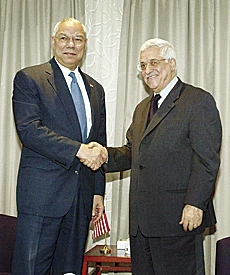
Yesterday, Powell met with PLO chief Mahmoud Abbas, Prime Minister Ahmed Qorei and interim Palestinian Authority president Rauhi Fattuh, among others.
Powell said both Israel and the Palestinians must return to the US-backed road map peace plan, which calls for a Palestinian state after requiring Palestinians to dismantle terror groups and Israel to freeze settlement building in the West Bank and Gaza. Before Arafat’s death, the plan was all but dead because of each side’s failure to implement the initial requirements.
When a group of voters in Jericho pressed Powell for a timetable for the creation of a Palestinian state, Powell told them, “It won’t be determined by picking a date, but by progress and action on the ground.”
Israeli Foreign Minister Silvan Shalom said it is in Israel’s interest to see the Palestinian elections go forward, saying they could pave the way for a new leadership “with whom we can sit down.”
“I have reassured the secretary today that Israel will do everything in its power to ensure their smooth running,” he said, adding that Palestinians would have “freedom of movement.” Shalom did not say whether Israel would pull back troops. Palestinian officials asked Powell to ensure that Israel do so, though it wasn’t immediately clear how he responded.
Shalom said Israel would coordinate the election with the Palestinians but would not compromise on security.
A senior Israeli official said the two sides were already in contact, and that a coordination meeting could be scheduled after the registration of candidates ends next week.
An Israeli official, speaking on condition of anonymity, said Shalom also told Powell that Israel is willing to resume talks with the Palestinians on other issues, including security.
Israel reoccupied West Bank towns during a 2002 military offensive aimed at halting Palestinian bombings in Israel. Troops have since withdrawn from some areas, but continue to enforce travel restrictions on Palestinians. Palestinians say they need freedom of movement for the election campaign and voting.
Palestinian Cabinet Minister Saeb Erekat said Powell told Palestinian leaders that “the United States will stand shoulder to shoulder with us to have free elections.”
— Additional input from agencies