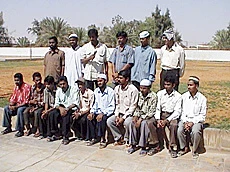
RIYADH, 26 November 2004 — What was supposed to be the start of good jobs for 18 Indian workers here has turned into a costly lesson about forged papers and a visa racket that has officials looking for answers. Eighteen Indian workers, who paid nearly SR9,500 each to an Indian recruiting agent in the hope of earning good salaries in Saudi Arabia, have no jobs and SR9,500 less than when they started.
Humiliated and empty-handed, the workers have been stranded in Riyadh awaiting their repatriation back home since Oct 15.
As the Indian Embassy looks into the matter, more questions are being raised about forged visas than are being answered.
The workers explained their woes to some Indian community leaders recently in an interactive session here.
“A number of workers are being sent from India and other Asian countries either on fake visas or on so-called free visas, which are part of a bigger racket,” said one community leader on the condition of anonymity. “Saudi officials should step up efforts to bust this racket before the problem gets compounded further.”
The 18 workers, mainly from Southern India, are being provided with food and shelter by community leaders.
The Indian Embassy, however, says the case has been solved. “We have now settled the case of the workers,” said V. V. Narayanan, first secretary at the Indian Embassy. “But we are waiting for the air tickets to be provided by the recruiting agent, who has his office in the Indian city of Calicut.”
Embassy officials met with the local representative of the recruiting agency, who said that the visas are “bogus,” raising more fears that an Indian visa racket may be operating on an international scale.
Whatever the case may be, it is widely believed that organized gangs of visa racketeers based in the Subcontinent, the Philippines, Egypt and a number of African countries have been operating for quite some time.
What Saudi officials are focusing on, however, is the question of how laborers have consistently managed to clear emigration in their own countries and enter into the Kingdom. Is there an arrangement between the criminal gangs there and a small number of corrupt officials?
Saudi authorities recently tightened the procedure for checking visas at the airports and the entry points of the Kingdom.
However, the situation is made more complicated by the fact that the laborers themselves usually have no idea that their Saudi visas are forged, raising suspicions that both guest workers and officials are being duped by a nexus of racketeers and corrupt officials.
“The workers have also refused to work for the Saudi company, where they have been sent,” the community leader said. “The company agreed to pay them SR400 per month salary. But, during the process, it was discovered that the visas endorsed on their passports are bogus.”
The name of the Saudi company and the Indian recruiting agency have not been released. but the agency may face punitive action.
This is not for the first instance of workers with fraudulent visas entering the Kingdom.
In a strange case earlier this year in Jeddah, police foiled a large forgery operation and seized a number of fake visas slated for sale in a number of Asian countries. The forgers disguise themselves as Saudis working in a construction company to cover up the operation.
Officers of anti-forgery department raided the hide-out of the forgers and arrested two of them with eight fraudulent visas.
In another case this year, 19 Indian workers with bad visas in their passports tried to enter the Kingdom at Dammam’s King Fahd International Airport(KFIA). They, however, were detained by the immigration authorities.
In fact, the black-market price of each visa, according to the confessions of forgers, ranges from SR5,000 to SR10,000. With those amounts of money involved and the level of corruption in many developing countries, the emergence of visa rackets was almost an inevitability.
It is in this context, where the issuing of visas has become big business, that racketeering has taken hold.