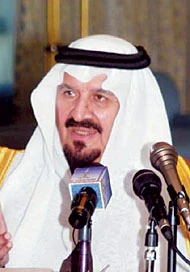
JEDDAH, 4 December 2004 — Prince Sultan, second deputy premier and minister of defense and aviation, formally inaugurated the Kingdom’s first civil aviation academy here yesterday. The opening of the state-of-the-art facility in the Khalediya area of the city has been described as a significant event in the history of Saudi Arabian Airlines.
Prince Sultan said the academy would welcome female trainees. “Conforming to the principles of Shariah, they can come with their husbands or brothers for training at the academy,” he added.
Prince Sultan laid the foundation stone for the academy in June 2002.
Prince Fahd ibn Abdullah, assistant minister of defense and aviation for civil aviation affairs, said the academy, which has been provided with advanced training facilities, would improve the airline’s performance and services. It will provide training to pilots, aviation engineers and cabin crew.
Prince Fahd said with the opening of the academy, the airline achieved self-sufficiency in its training needs. Saudia will not have to send its staff abroad for training, he added.
Prince Fahd highlighted the national flag carrier’s remarkable achievements over the past years, adding that Saudi Arabian Airlines has become one of the top 30 airlines in the world as per IATA classification. Last year, it carried more than 15 million passengers.
Dr. Khaled Ben-Bakr, Saudia’s director general, described the academy as one of the largest aviation training centers in the Middle East. A total of 160 Saudis have already graduated from the academy, he said.
“The academy will improve training of Saudia staff. It will also provide training to employees of other airlines,” Ben-Bakr said.
He emphasized the airline’s efforts to train and develop its manpower. “We have spend huge amounts on training programs for technical and administrative staff,” Okaz quoted Ben-Bakr a saying.
The academy, named after Prince Sultan, sprawls over an area of 29,643 square meters. It includes a pilot training center and aviation safety center. “The academy is designed to meet the airline’s future requirements,” Ben-Bakr said.
Training at the academy is provided as per the regulations set by the Saudi Civil Aviation Authority and American Federal Aviation Administration (FAA). “The academy will help Saudia achieve self-sufficiency in pilots, technical crew and other aviation staff,” said its director Capt. Muhammad Al-Deeb.
The facility will have six flight simulators. “Four are already there. The fifth will come in two months and the sixth will be installed later for new aircraft,” he explained.
The objective of the academy is to train aviation staff in the cockpit as well as the cabin crew and operation service employees to achieve high standard of safety and efficiency, Al-Deeb said.
According to Capt. Muhammad Muharrek, trainer for Boeing 747-400s, the academy offers advanced training programs to help trainees operate aviation systems with high efficiency. “Saudi Arabian Airlines has achieved world position in training aviation staff,” he added.
“The training programs at the academy will improve Saudia’s performance and make Saudi Arabia on par with advanced countries,” said Capt. Turki Aalam, supervisor for training aviation engineers.
The airline currently operates to 26 domestic airports and 58 international destinations.