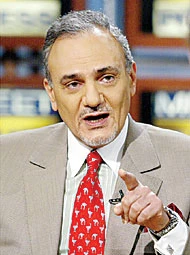
LONDON, 13 December 2004 — In a characteristically direct speech to the Defense and Security Forum, Prince Turki Al-Faisal, ambassador to Britain, set out in detail the war on terror from the Saudi perspective. His speech was made in the aftermath of the audacious attack on the US Consulate in Jeddah two days earlier.
“I believe there is no justification for terrorism of any kind anywhere,” Prince Turki said. “The horrific indiscriminate killing of innocent people goes against the basic belief of civilized man and the sanctity of innocent human life.”
His speech examined the evolution of the current phase of terrorism and the difficulty of tackling it in its current form, its financing, recruitment; he also asked how terrorists communicate and spread their messages.
He left the delegates in no doubt that terrorism is an indiscriminate evil which disregards race, religion and nationality and runs counter to the values of civilized mankind yet ironically divides them. “This evil force has divided individuals and communities and eaten away at our understanding of one another,” he said.
A major factor in fueling terrorism, he felt, was the glaring double standards applied to the Middle East by the US. This helped fuel the discontent underpinning the disaffection that terror organizations rely on as a seedbed for new recruits.
Referring to the attacks of 9/11 and others in the Middle East and Jeddah, he said that the attacks and the challenges we face in countering are global in perspective and have a global effect on stability, security, and economic well-being.
After reviewing the religious and political ideologies that have been used to justify terrorism in the past, Al-Faisal pointed out that Al-Qaeda asserted itself by claiming it is carrying out some twisted form of jihad. “They claim religious authority where they have none. In doing this, they have dragged Islam into a maelstrom of misunderstanding.”
He said that even though the international community — people of all faiths, Muslims, Christians and Jews — condemn this wicked perversity, it has driven a wedge between people, spread doubt and divided friends. “Religion cannot and must not be used in any way to justify terror,” he said. “The acts of Al-Qaeda and other terrorist groups are wholly wicked and totally unjustifiable. They defile Islam.”
Pointing to the 10,000 terror attacks that have taken place in the last five years, he said that over 300 groups had been involved and that the complexity of motives went far beyond a single philosophy. He moved further to separate terror groups from religion in general and Islam in particular.
Terrorism is funded by donations from sympathizers and by misdirected funds from charitable groups both inside and outside the Kingdom; much of the money is intended for humanitarian aid, Al-Faisal contended. “We also know that they are collecting funds worldwide through the drugs trade, money laundering and the fraudulent use of credit cards.”
The National Commission on Terrorist Attacks on the United States, an independent commission set up by the US government in the wake of 9/11, has recently reported that there is no evidence of Saudi government funding of Al-Qaeda. It concluded, “We found no evidence that the Saudi government as an institution, or senior officials within the Saudi government funded Al-Qaeda.”
To intercept any possible flow of funds, Saudi Arabia has set up a Financial Intelligence Unit to monitor financial transactions, a High Commission to oversee contributions and donations to charities and has also frozen all accounts suspected of having links with terrorist groups. An international Task Force in June this year concluded that the measures put in place by the Kingdom were in line with the best international practices.
Referring to the source of recruits for terror organizations, Al-Faisal said that the groups had fed on the unhappiness and discontent of disaffected youth. “They have turned their innocent disaffection into hate, and their youthful anger into terror.” The most dangerous element of today’s terrorism is its ability to inflict mass killing and destruction indiscriminately on civilians and non-civilians as in Beslan in Chechnya or in Madrid.
“The targeting of civilians on a mass scale marks an extraordinary turn in terrorism. These indiscriminate attacks have spawned a fear in the world community, a fear of movement and travel and a fear of one another.”
He stressed the determination of the Kingdom to pursue its anti-terrorism policy that was put in place long before 9/11. Quoting Crown Prince Abdullah, he said, “It is the terrorists who are our enemies, and security will be imposed on them by force. Every enemy will be tracked down, no matter how long it takes.”
In June 2004, the Saudi security forces eliminated the top terrorist leader of Al-Qaeda in Saudi Arabia, Abdul Aziz Al-Muqrin , and three of his closest aides. More of the terrorists have recently been arrested or killed. At present 19 of the 26 known senior Al-Qaeda operatives have been killed or captured and five of the six known operating cells in the Kingdom have been infiltrated and all but one eradicated.
The attack in Jeddah earlier this month, though disheartening, showed how swiftly and effectively Saudi forces can act. Four of the five terrorists perpetrating the attack were killed and the other was arrested.
Gently reminding the audience that making a generalization about a society from the actions of a few is unreliable, he quoted Crown Prince Abdullah, “The people who committed the acts at Abu Ghraib are a small group of deviants. I’m absolutely sure... that they do not represent the American people who have high moral standards. The people who committed those terrible acts on Sept. 11 were not representative of the Saudi people. The American people are pure and good as are the Saudi people. Small groups of deviants do not represent their respective societies.”
Al-Faisal identified four critical areas the international community needed to address in order to be effective in controlling terrorism. First, solidifying international cooperation on all fronts: Politically, financially and in the field of security. Second, putting in place effective preventive measures through intelligence sharing. Third, promoting cultural understanding through better dialogues between civilizations, cultures and religions and by promoting tolerance and thus defeating the preachers of hate. Fourth, resolving ongoing international conflicts that fuel terrorism.
He chose two pertinent cases: Palestine and Iraq.
Al-Faisal said that over 60 years ago, King Abdul Aziz warned both Neville Chamberlain and Franklin D. Roosevelt of the potential for conflict that lay in unresolved issues between Israel and Palestine. In a similar warning to President Truman, the king received agreement that “the Palestinian problem is the most difficult problem facing the world.” And Al-Faisal said,
“Here we are five decades later and it is still the most difficult problem facing the world. Why?” The answer, he said, was plain. “The world has used a set of double standards in dealing with our region, one rule for Israel and another for everyone else.”
When any other country flouted UN resolutions, he said, the reaction was ultimately swift and hard — Iraq was the latest example. “Israel has repeatedly flouted a multitude of United Nations resolutions calling on it to halt its aggression, to withdraw to agreed international borders, and to cease unlawful and forceful acquisition of property and land.” No action has ever been taken against Israel to force it to comply with even one of these resolutions. Instead the international community — and specifically the United States — has continued to supply Israel with billions of dollars worth of arms and support. “The idea of American and British solders invading Israel to force it to comply with UN resolutions appears to be as fanciful as the idea that the world will be invaded by men from Mars.”
On July 9 this year, the International Court of Justice condemned the Israeli wall and pointed out the damage that its construction would inevitably do to any prospect for peace. The court concluded that the wall violates the human rights of Palestinians and must be dismantled.
The ruling said that Israel is under an obligation “to cease forthwith the works of construction on the wall being built in the Occupied Palestinian Territories, including in and around East Jerusalem, to dismantle forthwith the structure therein situated.”
Israel’s response has been to carry on building. When complete, the wall will be over 400 miles long — four times longer than the Berlin Wall.
After cataloging a substantial list of statistics supporting the effective undermining of Palestine’s infrastructure and society through economic, physical and military measures, Al-Faisal said that Saudi Arabia, along with other Arab countries, has clearly expressed its interest in reaching a peaceful solution to the Arab-Israeli conflict which will be based on international legitimacy and the principle of peace for land.
Crown Prince Abdullah’s plan called for total Israeli withdrawal from the occupied territories, according to UN resolutions, in return for total Arab recognition of Israel. This plan was approved by all the Arab states and welcomed by the United Nations but remains unaccepted by the Israeli government.
In 2003 the Security Council adopted resolution 1397 that envisioned two states — Israel and Palestine — living within secure and recognized borders. “Yet ongoing Israeli actions destroy the possibility of achieving that vision. I believe, as do many others, both within and without the Arab world, that our fight against terrorism and for peace and stability will never succeed until a just and comprehensive solution is found for the Palestinian people in which they have the right to self-determination. This comprehensive peace requires determined action from the international community and particularly from the leading powers in the United Nations.”
Saudi Arabia has proposed that American and British forces should be replaced by Muslim forces in Iraq, that the United Nations, America, Britain and Muslim countries should sit down and discuss this proposition in all its aspects and ramifications. “We are still awaiting a response.”
Al-Faisal hoped that with new leadership in the US, there might be a real drive to find a peaceful solution for the region and, in doing so, to cut off the fuel that feeds terrorism. “The battle against terrorism is one we cannot afford to lose. To win it we must remain vigilant at all times in order to protect the innocent; we must act fairly in our dealings with individual nations and we must work together — as a unified civilized international community to rid our precious world of this evil.”