
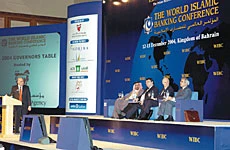
MANAMA, 13 December 2004 — Bahrain Monetary Agency (BMA) played an active role in creating a greater awareness about Islamic financial institutions worldwide, a top banking official has said. “BMA was probably the first regulator to develop regulations specifically addressing the unique features of Islamic banking,” its governor, Shaikh Ahmed ibn Mohammed Al-Khalifa, said.
In his opening remarks at the 11th World Islamic Banking Conference (WIBC), held under the patronage of prime minister, Shaikh Khalifa ibn Salman Al-Khalifa, he said “WIBC has become a key event in the conference calendar for all those with an interest in Islamic finance”.
The theme of this year’s conference, “Improving Performance and Ensuring Sustainable Growth in an Increasingly Competitive Global Market,” has been well chosen.
Over 600 delegates from 27 countries are taking part in WIBC exhibition which is concluding tomorrow.
“The various regulations will be re-issued next month in a single, comprehensive volume with the objective of enhancing the transparency and accessibility of our requirements.”
“We’ve also been working over the past 18 months to develop a comprehensive framework for the insurance industry, following the transfer of regulatory responsibility for this sector to BMA two years ago. These regulations are now nearly finalized and will also be published in January.”
“These regulations will specifically cater for takaful insurance as well as conventional insurers. In doing so, BMA is again taking a lead in regulatory developments,” he said.
“We see sound regulation not as an end in itself but as an essential pre-condition for a healthy financial system, one more likely to enjoy stable, long-term growth.”
“In Islamic finance and takaful, sound regulation is doubly important in helping achieve worldwide credibility for the industry. Unfortunately, there are still some who associate Islamic finance with weak regulation. Islamic finance is coming of age,” Shaikh Ahmed said.
“It’s losing its niche status and achieving growing recognition and attention from the global financial industry. It’s experiencing strong growth and demonstrating credible innovation in developing new products and markets.
“At the same time, takaful, or Islamic insurance, is now beginning to develop in a significant way and stands to benefit from the experience gained in the Islamic banking and finance sectors. In short, the future looks promising, God willing,” said Shaikh Ahmed.
“However, there are challenges ahead, and this is a good moment for the industry to take an objective look at itself and identify the issues it needs to address in order to ensure that recent performance is sustained.”
“These opening remarks are not the place in which to explore such possible issues in any detail. But I’d like to touch briefly on three areas for you to consider over the course of this event. BMA has played an active role in helping educate the global financial community, and much progress has been made.”
“But the need to overcome misconceptions remains,” said Shaikh Ahmed.
“For those in the industry and those involved in its regulation, the challenge is clear: We must continue to work to enhance best practice and compliance with international standards. For institutions, this includes the need to implement sound corporate-governance and transparency standards.”