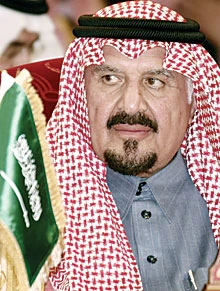
MANAMA, 21 December 2004 — Saudi Arabia yesterday called on Gulf leaders to strengthen their ties and unite their voices. “We (the Gulf leaders) meet under one roof in Manama in disturbing regional and international circumstances,” said Prince Sultan, second deputy premier and minister of defense and aviation.
Leaders of the six-nation Gulf Cooperation Council (GCC) began their two-day annual summit in Manama yesterday amid tight security measures. Bahrain’s king, Sheikh Hamad ibn Isa Al-Khalifa, opened the summit with a short speech. “We have always been a symbol of coherence and integration and we will continue to be so,” the king told the GCC leaders.
“We trust that Bahrain’s king will aim to achieve that goal, the goal of unity — it is an international need,” said Prince Sultan, the leader of the Saudi delegation. “The Bahraini leader is wise in his decisions and the region needs a strong push to continue its goals. The Gulf region needs to strengthen its presence in the international community. The GCC was set up to achieve certain goals of the citizens and that project should continue. The leaders will continue to achieve the goals set by the citizens. We are heading toward reforms and development,” he said.
Prince Sultan said that the “Zayed Summit” will continue to serve the late president’s goals and dreams. King Hamad declared on Saturday that the 25th GCC summit would be called the “Zayed Summit” in honor of the late president of the UAE, Sheikh Zayed ibn Sultan Al-Nahayan, who died last month.
The differences over the Bahrain-US Free Trade Agreement, signed in September, will not be discussed at the summit, GCC Secretary-General Abdul Rahman Al-Attiya, told Arab News. “The FTA agreement will not be on the summit’s main agenda, but if the leaders raise it the issue will be discussed,” Attiya said.
“What has been agreed between Bahrain and the United States does not bring any harm to any GCC country,” Bahraini Finance Minister Abdullah Saif told reporters earlier. “The US market is estimated at around 250 million consumers and it can be very beneficial to the Gulf states to reach agreements, either bilateral or as a bloc, with the United States.” The agreement has been strongly criticized by Saudi Arabia. Saudi Arabia, the only Gulf country with a land link to Bahrain, is the largest Gulf economy. Experts say it fears US goods imported tariff-free into Bahrain will be resold in Saudi Arabia.
The United States is seeking similar free trade deals with Oman and the UAE as part of efforts to create a Middle East and North African Free Trade Zone by 2013.
In a related development, Bahrain’s Minister of State for Foreign Affairs Mohammed Abdul Ghaffar said yesterday that bilateral talks were enough to resolve the dispute between Saudi Arabia and Bahrain over the Bahrain-US agreement. “The matter is being discussed and we do not want to give it more attention than it deserves,” the minister told reporters after the summit’s inaugural session. “Saudi Arabia has its point of view. Other countries have their points of view. We are discussing the matter and discussions are a way to reach a common ground,” he pointed out.
The minister denied that the free trade agreement with the US violated GCC customs agreements. He said there was no danger of freezing the GCC customs union and mentioned that there had been obstacles in the past which prevented implementation, but discussions were taking place so those obstacles could be overcome.
On other topics on the agenda, Abdul Ghaffar affirmed that security was of prime importance; he said that the leaders had discussed ways not only to strengthen security among GCC states, but to include neighboring countries as well. “Security is a very important issue for us and it was on the agenda of the summit. There are existing security arrangements between GCC countries at present. The question is how we can engage Iran and Iraq with the GCC and with other countries who have interests in the region,” he said.
Abdul Ghaffar stressed that security and stability in the Gulf was a guarantee of the region’s economic and political development. “It’s extremely important that we understand security is very much connected with political and economic development of the region. Without security we may not prosper in other areas,” he stressed.
On the question of elections in Iraq and whether GCC countries agree with the timetable set by the Iraqi government for the poll, the minister said that in general, most countries agree with the elections because they would be “the first step to stability in Iraq.”
“However, there are some different opinions on the timing. Some countries say it would be better to postpone the elections. Others say that postponing them would not be a good idea,” he said. “We look positively for the Iraqi elections to be held and the basic constitution now in Iraq protects the rights of all political and ethnic groups so that no political group can dominate another,” he added. “This is the essence of democracy which is to include all sects of society in the political process.”
Pertaining to reforms in the region, he said that he preferred the word “renewal” instead of “reforms.” He pointed out that it was necessary for any country in the 21st century to move ahead and renew itself but stressed that every country has its own circumstances and its own problems. He cited the example of Bahrain, saying that the Bahraini Constitution guarantees rights to all citizens and residents. He affirmed that the country was on the right path according to its needs.