
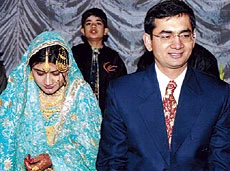
Today Ahmad is relaxed and content. This was achieved only after more than three years of anxiety, of tension and extreme pressure. Only last week Ahmad’s daughter was married here in Saudi Arabia. “It was very satisfying as the ‘nikah’ was done in the Holy Haram,” said Ahmad.
Ahmad’s story is a dream of many Indian expats living in the Kingdom. Unfortunately, it remains only a dream for many. In fact, the sight of growing daughters elicits mixed responses from parents — joy in addition to anxiety. These feelings spring from the problem of a husband for the girls. Currently the problems can be broadly categorized as follows:
• Finding a suitable husband for girls born and brought up in Saudi Arabia.
• Finding a husband for girls whose parents have been here for so long that contact with their community in India is tenuous. In some cases, the girls are sent to India for higher education.
• Finding a husband for girls whose families have made money here but who were not well-off or in the social swim in India. Parents who have improved their financial situations do not want to give their daughters to men whose status is the same as theirs when they were there. And, of course, a husband from a higher class is not a possibility.
• Husbands who demand exorbitant dowries.
Although marriage has always been a problem, the main reason for its remaining so is the change in the family. Indians in the Kingdom are faced with the fact of having spent so little time at home. And when one is out of sight for a long time, one is soon also out of mind — at least to those who matter.
Families who have been in the Kingdom for a long time and whose children have grown up here are perhaps the worst affected. The reality stares parents in the face: Their children are used to a different way of life from that in India. Parents often want to choose a husband from their area. Traditional thinking leads them to believe that their children should marry in their own culture. Many times, however, this is at odds with the new, more “globalized” generation. There is always the apprehension in the minds of parents that girls brought up here who marry boys brought up in India will have problems of compatibility and expectations. At the same time there are Indian families who feel that girls brought up in the Gulf are too easy-going, lazy, arrogant and hence unsuitable.
The mechanisms of marriage are basically simple. Initially, the boy’s parents or older family members see the girl at some social function. Inquiries are made and if they are seen as suitable, some contact is initiated with the girl’s family. In other words, the girl’s appearance as well as her family background are important factors. In the case of the parents being in Saudi Arabia and daughter in a college hostel in India, the whole process never takes off.
Dr. Hassan, a doctor who has lived in Saudi Arabia for more than 20 years, recently returned to the Kingdom after his daughter’s marriage in India. He had a harrowing experience; he tried every imaginable means to find a suitable boy for his daughter. He advertised in leading Indian newspapers and even gave his daughter’s details to well-known Indian matchmakers. What happened, however, was upsetting.
“The advertisement got responses after three weeks and then it was time for me to return to Saudi Arabia. I could only see a few letters and had to wait for my relatives to send me the others. All this took a long time and since I had to leave, I could not possibly go and see the short-listed candidates. I had to trust my relatives or friends. Seeing the situation, it was very difficult for relatives and friends to get involved to the extent that was required.”
Dowry is another problem though few are willing to talk about it. Girls brought up in Saudi Arabia, according to Indian ideas, should bring large dowries. Indeed, many expect half a kilo of gold as part of the dowry. “I have been match-making for a long time and my aim is to help people. I am very happy when I am able to play a positive role,” said Muhammad of Karnataka. “I have seen many families who are desperate, living in constant tension,” he said. “Recently I have had to deal with a difficult situation. A north Indian boy came to me asking for a suitable girl. I showed him one girl’s details and they were acceptable to him. His family got in touch with the girl’s family in Saudi Arabia. Initially both families were pleased but later the boy’s mother backed out, saying that the girl was a Canadian citizen and that she was likely to take the boy away from his family. The mother preferred a girl who posed no such threat.”
On the other hand, there is the case of the only daughter of a wealthy immigrant to Canada. Now in her early 30s, she has all the qualities one would look for but her parents are unable to accept a proposal because they fear that the groom is only interested in their wealth or in Canadian citizenship.
Modern technology seems to be getting its due and there is a growing trend to use the Internet. Ahmad found his son-in-law through the specialized websites. “When we are far away from our families, the Internet is a great relief. To some extent this compensates for the loss of the extended family structure,” he said.
The situation is both grim and challenging. Parents who have been in Saudi Arabia for a long time have to adjust to the realities of a changed scenario. They may think of Saudi Arabia as their “home” and plan to recreate an ambience of family — but is this really a possibility?
Parents here should start to circulate within the Kingdom. There is the possibility of organizing meetings or conferences at which parents could meet and get to know others. This would create a special circle of possibilities for brides as well as grooms. Local newspapers could also be used and well-known people in the Indian community should also get involved and help in solving some of the problems.
(Some names in this article have been changed to protect their privacy.)