
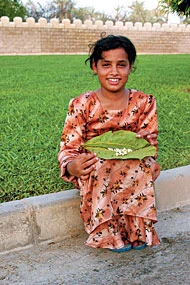
"Jasmine!” “Jasmine!” The children are not calling a friend nor are they trying to see who is the loudest. They are selling some of the worlds most fragrantly perfumed blossoms, the Arabian jasmine (Jasininum Sambac).
“Timid jasmine buds that keep their fragrance to themselves all day,
But when the sunlight dies away,
Let the delicious secret out,
To every breeze that roams about.”
The 16th century poet clearly knew the secrets of jasmine and how it releases its delightful secret after sunset, thus transforming a warm Arabian evening into an olfactory delight for those caressed by that breeze.
Though close to modern Muscat, the small coastal village of Al Bustan is still, at heart, at least an agricultural community. Its jasmine fields are renowned among the local population but practically unknown to foreigners.
Jasmine is a member of Oleaceae — the olive family — but unlike the olive, the Arabian Jasmine grows into a small scraggly bush. The conditions in Al-Bustan are ideal for the bush as it needs sunlight and well-tilled soil with plenty of water during the flowering season.
Unlike many tropical flowers, the flower of the jasmine is not showy or spectacular. Pale milky white with a slight sheen and about a centimeter across, the attention the flower attracts is due simply to its perfume and its jasmine has perfume oil extracted from it for fragrance and aromatherapy. Its uses in aromatherapy include lifting the sprit and easing nervous exhaustion.
An extraordinary number of petals — possibly 8,000 — are required to make a single gram of oil; for a kilo the number is something around 8 million. The oil is indeed worth its weight in gold. The Arabian peninsula jasmine, however, is grown for its lovely flower and its natural fragrance.
During the warm nights of the Omani summer, the white flowers of the Arabian jasmine begin to open. Growing in open areas beside the omnipresent date groves, the scent is carried by the slightest breeze. It finds it way through the darkness to those outside and is even detectable in the village houses. The flowers are normally harvested at dawn while they are only partially open and before the sun’s heat can affect them.
Women whose families own the gardens, pack the flowers for sale in a charming yet very special way. Some flowers are placed between the large leaves of an Indian Almond (Terminalia catappa) tree; a flexible strip of date palm leaf is then sewn in order to join the two leaves. In this way not only are the flowers protected but also sold in their own unique container that can be used as a fan to waft the scent in all directions as the air cools.
For some people the extraordinary fragrance of the flowers is justification enough for buying them; for others, especially women from Yemen and southern India, the flowers are sewn into a chain and then used to adorn the hair.
In Oman, perhaps one of the most delightful uses of jasmine is on a child’s first birthday. In the northern area of the country, the first birthday is called ‘hol hol’ — after the classical Arabic word for one year. The jasmine flowers are sprinkled over the child’s head while other children sit in a circle and sing the simple words ‘Hol Hol.’
After harvesting and packing, it is now up to those very persuasive children to sell the finished product. Sitting on the road-side in the late afternoon they call out to likely customers passing by and invariably, the entire day’s stock is gone in half an hour or so.
For the unfortunate many who have never smelt what is called the ‘King of Flowers’, take the first opportunity possible to make a purchase and enjoy the fragrance of the Arabian jasmine.