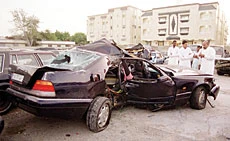
JEDDAH, 3 January 2005 — An Arab News investigation has revealed that insurance fraud is rampant in Saudi Arabia. At times, it even takes place under the very nose of the traffic police department. This journalist’s car was recently involved in an accident — hit by a speeder racing at 60 km/h through a small intersection. The side-impact released the airbags and spun my car around 180 degrees. Neither my friend — who had borrowed my car — nor the other driver were hurt. The police were called and a report was filed at the scene of the accident.
Worried at how I would react to the news that my car had been wrecked and wanting to cause me the least possible inconvenience, my friend tried to spare me, taking care of most of the paperwork through his friend in the traffic police. I was not told about the accident nor the decisions that were being made regarding it for about six hours.
The problem facing my friend was that my car’s insurance did not cover him — or so we thought. It was his understanding as well as mine when I gave him the car key, that in the event of an accident, neither he nor my car would be covered. Anyone driving my car would have to have their own insurance which would cover damage to my car or the other car involved. Considering my friend’s urgent need for a car in what was a real emergency, I decided to take the risk and lend him mine.
The damage to the other car was about SR6,000 and the damage to mine, according to the second-rate workshops which the police allow to do damage estimates, was about SR12,000. The actual cost of getting my car fixed, according to the dealership, was SR23,000.
My friend contacted an officer he knows in the traffic police. The officer told him to go to a particular insurance company that day — after the accident had already taken place — and buy liability insurance that would pay for the damage to the other car. What the officer would do was to change the date of the accident to the day after the insurance was bought; that would assure that the other man’s repairs would be paid for, not by my friend, but by his new insurance company. Because both drivers now had insurance, the police report was made to reflect equal responsibility, thereby making both insurance companies share the cost of the accident equally.
Of course, this did the other driver’s insurance company a favor at the expense of the new company. In other words, my friend’s new insurance company was about to pay damages for an accident it really was not involved in. When I was finally told about the accident, my friend already had in his hands the paperwork to perpetrate this fraud — prepared, signed and stamped by his friend in the traffic police.
I immediately contacted my insurance company and learned that repairs to my car were covered so long as the person driving had a valid license — which my friend did. My car’s insurance covers me fully when I am the driver; however, if another person drives my car, the insurance only covers the damage to the car. Anyone driving my car would have to have separate liability insurance to cover any loss caused to another party. This is what my friend didn’t have.
When I went to my insurance company, I filed an accurate accident report, providing the insurance company with the other driver’s insurance details and also those of my friend. For the purposes of what became an Arab News investigation, I didn’t tell my friend or the traffic police the good news from my insurance company; I was curious to see how far the fraud would go.
I approached my friend, and his “wasta” (the police officer) and presented them with the following “problem”: My car would cost SR23,000 to repair. The other driver’s insurance would pay almost SR6,000. Where was the remaining SR17,000 to come from?
The policeman, wanting to be of service to our mutual friend, explained the second stage of the plan which, if implemented, would pay for repairs to my car at the dealership and would allow my friend to keep the money — almost SR6000 paid by the other driver’s insurance company. The paperwork meant to be presented to the insurance company, which was prepared by the police would make our friend the beneficiary of the insurance check. He would cash the check and do whatever he liked with the money. In a few days, a separate fraudulent accident report would be completed, stating that I was the driver in a different accident and was 100 percent at fault. With that, I would go to my insurance company and they would pay for the complete repairs which occurred as a result of the “first” accident. The plan was so simple and set to be executed with such finesse that one had to question how many times before this had taken place before.
At this point, I took my friend aside and explained that what he and the policeman were about to do could land us all in jail. Once he had had time to think of how serious the matter could easily become, he decided to leave the new insurance company out of the equation. We obtained an accurate copy of the accident report and bid farewell to corruption.
My car has since been taken to the dealership for repairs which will be fully paid for by my insurance after going through all the normal, legal channels. The repairs to the other car were paid for by my friend who had to borrow the money from a relative.