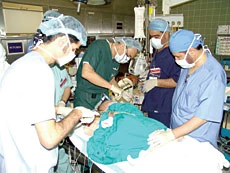
RIYADH, 4 January 2005 — The Polish conjoined twins, 14-month-old Daria and Olga Kolacz, were successfully separated and they were reported to be safe and sound after a ten-stage operation lasting 15 hours at the King Abdul Aziz Medical City for the National Guard yesterday.
The surgery commenced as scheduled at 7.30 a.m. when Dr. Mohammed El-Gamal anesthetized Olga initially followed by Daria without any complications. By noon, the surgeons had successfully completed three phases of the operation by dissecting the intestines, anus and urological system. Separation of the spinal cord which began at 4.30 p.m. took four hours to complete the process. The surgery ended 15 minutes ahead of schedule to the loud applause of the twins’ mother and the medical team present. The twins were born on Oct. 8, 2003 to a seamstress mother, Wieslawa Dabrowska, at the Centrum Matki Polki Institute in Lodz, Poland. They were brought here after Crown Prince Abdullah agreed to a request by their mother to have a surgical intervention to separate them. Yesterday’s complex surgery was the ninth of its kind at the hospital and was performed by a 25- member medical team headed by the Chief Executive Officer(CEO) of the hospital, Dr. Abdullah Al-Rabeeah.
“People in all parts of Poland were glued to the television watching the surgery live. This made every Pole realize the noble gesture of the Saudi government in helping those distressed,” the deputy head of Polish mission here, Andrzej Wozniak, told Arab News.
The mother looked tense at the commencement of the surgery and a special attendant was present to console her and keep her calm throughout the surgical process. She prayed and kissed her children before the doctors got down to their task. Polish pediatrician Dr. Jolanta Jezewska, supported by the diplomatic staff of the Polish Embassy including Ambassador Adam Kulach and his wife Olga Kulach, were kept on tenterhooks till the babies came out of the operation theater.
“The day of separation of the twins is the happiest event in my life. I am optimistic of the results of the surgery,” Dabrowska told Arab News. The mother who was tense at the beginning of the surgery was relaxed as the operation progressed without a hitch through its various phases. Dr. Rabeeah emerged from the theater every two hours and found time to keep the mother informed on the progress of the surgery.
Prior to the surgery, Dr. Rabeaah indicated to the mother that clinical and neurological examinations showed weakness in the muscles and nerves supplying anal and sphincter, pelvic floor and lower limbs, especially the right leg of Olga. Dabrowska agreed to proceed with the surgery acknowledging the potential risks.
Daria and Olga Kolacz, who arrived in the Kingdom on Dec. 12, underwent a course of presurgical tests for a fortnight to confirm a safe separation of the babies.
The twins were joined at the abdomen, pelvis, buttocks and spine. They shared one anal canal and rectum with adherence of their lower urinary and genital systems. Daria had a complete urinary and genital system whereas Olga had a single abnormal kidney with complete remaining urinary and genital system. There was a union of lower aorta (major artery of the abdomen) and vena cava (major vein of the abdomen) and also shared a common lower spinal (I cord) with possible overlap of the nerves supplying the pelvis and lower limbs.
Since 1990, a total of nine surgeries for separation of conjoined twins have been performed in the Kingdom. Three pairs of twins were from the Kingdom, two from Sudan and one each from Malaysia, Egypt and Philippines. The last one was early last year when doctors successfully separated eight-month-old Filipino conjoined twin girls who shared an abdomen, pelvis and lower organs.