RAMALLAH, 14 January 2005 — The Palestinians intend to start carrying out security commitments under a US-backed road map charting a path to statehood and peace with Israel, President-elect Mahmoud Abbas said yesterday.
The plan, in its initial stage, calls on Palestinians to end all violence and crack down on fighters while Israel is meant to withdraw forces from some areas and freeze settlement growth.
Abbas, elected on Sunday to succeed Yasser Arafat as president, has urged groups to cease fire after four years of bloodshed, but he has said he wants to co-opt rather than confront them.
“The road map starts with security commitments and then moves on to final-status issues ... we are ready to implement our commitments,” said Abbas.
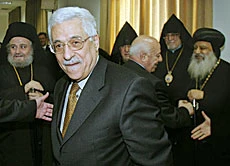
Abbas, speaking to visiting Christian clergymen, urged Israel to carry out its obligations under the plan.
Israeli Prime Minister Ariel Sharon, widely expected to meet Abbas soon, has said a crackdown on fighters was essential to any revival of peace negotiations.
“The question now is whether he (Abbas) has the will and determination to bring Palestinian terror to an end,” said Israeli Foreign Minister Silvan Shalom. “His test is now.”
A senior Palestinian official said Israel and the Palestinian Authority were holding informal contacts via third parties on a possible Israeli pullback from West Bank cities, where police would try to keep anti-Israeli violence in check.
In the Gaza Strip, Israeli troops shot dead a Palestinian who was driving his pregnant neighbor to hospital while the army was carrying out a nighttime raid.
In another incident, Israeli soldiers killed a Palestinian in El-Bureij refugee camp in Gaza, the army said.
A leading Hamas official said yesterday the group was open to stopping violence against Israel.
Sheikh Hassan Yousuf, top Hamas leader in the West Bank, also said the group is not trying to destroy Israel. The comments were a marked departure from Hamas’ usual calls for elimination of the Jewish state.
A halt in attacks by Hamas, which has carried out dozens of bombings that killed hundreds of Israelis during four years of conflict, would give Abbas an important boost in his efforts to restart peace talks.
Yousuf, who is among Hamas’ founding members, is known as a relative moderate within the group, and other leaders couldn’t immediately be reached for reaction. The group’s main leaders are based in Syria and Lebanon, and they usually stick to the movement’s uncompromising line against Israel.
Yousuf said the group is reconsidering its violent tactics, though a final decision hasn’t been made.
The official ideology of Hamas does not recognize a place for a Jewish state in Middle East. However, in the past, its founders and leaders have said they would accept a temporary Palestinian state in just the West Bank and Gaza Strip in the framework of a long-term cease-fire with Israel, but Hamas would not make peace with Israel.
Yousuf said Hamas understands that the Palestinian people are wary after more than four years of fighting. “We read the regional and the international reality and the changes that have taken place based on this reality, and we take positions according to these changes,” Yousuf said.
“Hamas doesn’t want to eliminate Israel. Hamas is a realistic political movement,” he said. “There is a thing called Jews and a thing called Israel and we deal with this reality.”
On Wednesday, Mahmoud Zahar, a top Hamas leader in Gaza, said Hamas has no plans to disarm, and Abbas has no authority to order an end to attacks on Israel.
Despite Yousuf’s comments yesterday to The Associated Press, Israelis were skeptical.
“We’re going to have to see what the reaction is. This guy has a reputation for piping off,” cautioned Mark Heller, an analyst at the Jaffe Center for Strategic Studies at Tel Aviv University. “I don’t think he was speaking for the (Hamas) movement.”
A senior Israeli official, speaking on condition of anonymity, called Hamas a terror organization and said Israel would deal only with Abbas’ Palestinian Authority.
After Yousuf was released from an Israeli prison on Dec. 3, he endorsed the long-term truce formula and said Israel and the Palestinians could live in peace, a statement taken at the time as a sign of a new moderation among local leaders of the group.
Since then, Hamas has not carried out bombings inside Israel, though the Israelis attribute that to success of their security services in foiling plans and arresting fighters.
Also, Hamas fighters in Gaza pelt Jewish settlements there and Israeli towns just outside the fence with rockets and mortars on a daily basis, countering any feeling that the group is abandoning violence.
Israel insists that Abbas dismantle the fighter groups, according to the terms of the road map peace plan, backed by the United States, United Nations, European Union and Russia.
Instead of cracking down, Abbas has been trying to prod the fighters into a truce. In his brief tenure as prime minister in 2003, Abbas succeeded in forging a cease-fire to halt attacks against Israel, but it collapsed after a few weeks amid Palestinian bombings and Israeli reprisals.
— With input from agencies