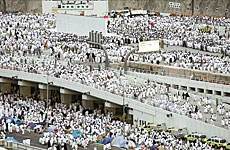
MINA, 21 January 2005 — The sprawling tent city of Mina went into a celebratory mode as an estimated three million pilgrims performed with ease the important yet dangerous ritual of stoning the devil.
“Everything went according to plan and by the grace of Allah we have had no untoward incident at the Jamrat,” said elated representatives of the tawafa organizations. The arrangements were impeccable and all care was taken to avoid massing of pilgrims on the Jamrat Bridge which has been a scene of tragedy on numerous occasions in the past.
Helicopters hovered constantly overhead to monitor the huge crowds with the help of hundreds of high-tech cameras, all connected to a control room run by top security authorities.
The pilgrims began their trek from Muzdalifa back into Mina early yesterday morning. But instead of rushing to the bridge they first went to their camps and then came out in groups of 700 to complete the stoning ritual.
The faithful threw only seven small stones at the first pillar known as the “big Satan” or Jamarah Al-Aqaba. The “Stoning of Satan” continues over the next two days during which pilgrims hurl seven stones every day at each of the three modified pillars standing 155 meters apart.
The stoning ritual takes place at the site where Satan appeared to Prophet Ibrahim, his wife Hajarah and son Ismail. Ibrahim and his family each threw seven stones at Satan. The gesture has been perpetuated, and Muslims must perform it to complete the Haj.
Security measures were beefed up around the pillars and full medical facilities were in place in a bid to avoid the recurrence of stampedes that have claimed hundreds of lives during the ritual in recent years.
Once the pilgrims came out of the state of ihram, they congratulated each other. “But let us not forget our brothers in Iraq, Palestine and Kashmir,” said Sulaiman Maddah, who came from Abha for Haj with his family. “Our celebrations should be tempered because of what is happening in our backyard. Things are very bad. We have prayed here for the betterment of the Ummah. Let us hope Allah will answer our prayers.”
Malaysian pilgrim Hussam Ismail Raheman was happy to perform Haj comfortably. He said Muslims are being projected as “terrorists” by the West.
But those people should come here and see for themselves that how organized, well-behaved, helping and caring they are. Haj is the best example of our brotherhood and the concept of Ummah.
“I am happy that Saudi Arabia provides best possible help and assistance to the pilgrims. The maintenance and upkeep of the holy sites are also remarkable. And the security, medical and religious services are all exemplary. I have not seen such warmth and courteous people anywhere,” Raheman said.
A pilgrim from tsunami-affected region of Aceh was very excited and satisfied after performing the ritual of stoning the devil. “I saw nature’s fury eyeball to eyeball. I survived. But I was worried what will happen to me during this ritual. Alhamdullilah, everything passed off peacefully and smoothly. All my fear and anxiety were dispelled,” Hani Samsuddin said.
Pilgrims were seen in new colorful clothes and happiness was writ large on their faces. They were exchanging pleasantries and wishing each other well. There were long queues at the makeshift telephone booths from where pilgrims were calling home to assure their near and dear ones that they were safe and sound.
A pilgrim Izhar Hussain from Pakistan recalled how he survived Mina fire in 1997 which had claimed over 300 lives. “I was near the King Khaled Bridge when the blaze began. Everybody was running to save his life. I climbed the hill near Jamrat. After 7 years I find this place more safe and secure. Facilities have been improved. Fire-proof tents have made lives safe.”
“The stoning of the Jamrat has been made easier. Its size is so big now that it is seen from a long distance. And since the circle around the pillars has been removed the flow of pilgrims has increased tremendously,” Izhar said.
The whole area around the Jamrat Bridge has been expanded. It’s a totally changed place, said Said Ali Al-Shamri, a Qatari.
“I had explained the whole thing to my wife who came this time with me. But when we came here everything was changed. From the Jamrat pillars to roads and even the sidewalks have been given a new look. A complete overhaul. But thank God, the change is for good. It has improved facilities here,” Shamri said.
The fear and anxiety of the pilgrims related to the stoning ritual have been reduced to a great extent. The people who performed Haj this year thanked the Saudi government.
“Now even older and weak people can go and perform this rite on their own. Risk factor has been reduced considerably,” Ikramuddin Mohideen from Kenya said.