MINA, 21 January 2005 — For pilgrims coming from abroad, the easiest way to complete the ritual of slaughtering a sheep or a camel before they can come out of the state of ihram is to buy the coupons from the Islamic Development Bank which runs the massive sacrificial meat project. However, many pilgrims prefer to buy sheep or camel at the abattoirs on the day of sacrifice and slaughter it themselves.
This year, the price of sheep went up by more that SR70. “I don’t understand why the price of sheep keeps rising. They rise every year. I was approached by somebody from Aziziyah in Makkah who said he will provide a sacrificial goat for just SR300. But the problem is I cannot go out with him to Makkah and come back I am in ihraam and want to complete this ritual as fast as I can. So I am paying but reluctantly,” said an Indian national Iqbal. He was about to slaughter a sheep at the Mina slaughterhouse.
For Amin, a 35-year-old American pilgrim from New Jersey, sacrificing a goat is an experience in itself. “I came here at the slaughterhouse to see it all and to do it myself,” he said.
In the true tradition of Islam, he ensured that the goat he bought for the first time had no defective eyes or ears and that it had no physical disability. “This is Sunnah and I am doing what is expected of me from my religion,” he told Arab News. But just when he was about to sacrifice the goat he hesitated and asked butchers at the slaughterhouse to do the job. “I was afraid I will not get the right vein,” he said.
Abdul Hameed, a 43-year-old Pakistani pilgrim, said: “I like to sacrifice these goats myself because this entails lot of ‘ajr’ in the Hereafter. You don’t feel like having performed Haj if you don’t perform the sacrificial ritual yourself. Back home in Pakistan Eid Al-Adha is not complete without we sacrificing sheep ourselves.”
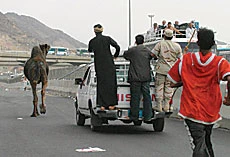
Abdul Jalil, from Myanmar, bought a camel for SR2,000. “This is cheaper for me. I have to sacrifice for seven people so a camel is ideal. Plus camels are not costly. For some reason, the price of sheep is jacked up. Maybe because they are in huge demand.”
Jalil had no intention of sacrificing the camel himself. He was waiting in line at the slaughterhouse for the assistants there to help him carry out the task.
“I will take part of the camel meat and distribute it among some of my relatives in Makkah. They will be happy,” he added.