
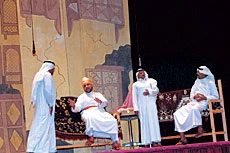
Recently in Madinah, a play entitled ‘Jaba Ya Hooh’ was presented at the Prince Muhammad ibn Abdul Aziz Cultural Hall.
The play was in the Makkah dialect and the word ‘jaba’ is primarily used there to welcome guests informally. According to the director of the play, Badi Al-Tamimi, the play was an important achievement for drama enthusiasts in Madinah.
He said, “By cooperating with the Madinah Cultural and Art Committee, we are trying to present more dramatic activities for the public. The lack of financial and moral support is of course an obstacle. We are also unfortunately neglected by the media, both newspapers and television. There are a number of talented actors here who need support and understanding from officials. I have my own dramatic group which I set up ten years ago. We have taken part in a number of different activities including the Janadriyah Festival; the last time we were there was in 1424.”
The play is about Ahmad Al-Sebaie who is considered a cultural icon trying to work with his friends to improve the Kingdom’s cultural and social status.
Al-Sebaie was one of the first people who called for women to be educated, for freedom of the press and for the revamping of certain social institution. He believed in the theater and the importance of theater in social life. In the early 1960s, he established the ‘Quraish Theater’ in Makkah and assembled a dramatic group to rehearse and present two plays. Al-Sebaie sent invitations to many people asking them to attend the performances.
People rejected the idea of theater and thought it was a first step which would lead to a nightclub in the holy city of Makkah.
The plan to build a theater was thus demolished before it was even a building. There are not many additional details about Al-Sebaie’s bold attempt to establish a theater in the Kingdom.
What is known about him is that he was a man of great imagination who wrote short stories in which history and comedy are mixed with a master hand. Saudi Arabia has now seen the introduction of many things unimagined in the 1960s — video, Internet and satellite TV — but still has no live theater.
The characters in the play are: Ahmad Al-Sebaie, Ahmad Kendeel, the poet, journalist and radio presenter, Taher Zamakhshari, the poet and radio presenter who was known as Baba Taher. Another character in the play is Kaja, a well-known crazy man in Makkah. Al-Sebaie wrote about him in a book entitled “Diary of a Crazy Man.”