
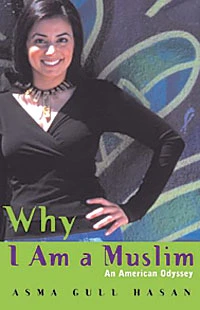
We all know why we are Muslims. What difference will writing about it make to others? That is the question Asma Gull Hasan poses in her book ‘Why I Am a Muslim: An American Odyssey.’ She asks, “If the world had no Muslims, would we have no problems?” Asma was born in Chicago and grew up in Colorado; she is a contributor to The New York Times, The San Francisco Chronicle, and The Denver Post and she now lives in San Francisco.
A graduate of Wellesley College and the New York University School of Law, Asma is one of the few brilliant young Muslim Americans, not only able to write clearly but also aware of how to write with both tact and truth. She makes the best of the freedom of speech and expression that is alive and still kicking in the United States.
“I was born a Muslim. When you are born a Muslim, you are born with the history of Islam behind you. The birth of each Muslim continues the epic of Islamic history,” writes Asma. “My Islamic ancestors were great scholars, conquerors and philosophers. They invented algebra and modern navigation. They brought peace to Arabia, Spain and India,” she continues. She goes on to elaborate the reasons for being a Muslim at which point, many of us will cry out, “We know these reasons.” True enough but how many of us have really thought about it and tried to articulate them eloquently and lucidly so that we may not only increase understanding and knowledge of Islam and Muslims but in the process become better Muslims ourselves.
Historically and even today Islam has had few problems with science. “Scientific discovery is religious discovery because God created the secrets of the universe for humans as signs,” she adds. “Because Islam is a woman’s religion,” is the title of an entire chapter. “It was Lady Khadijah (the Prophet’s wife) who first accepted the teachings and prophecies of Muhammad (pbuh). One of the world’s greatest religions was built upon the belief of a woman in her husband,” writes Asma. She notes that with a rich tradition of strong Muslim women and clear language in the Qur’an which stresses women’s rights, she knows where she stands as a Muslim woman. “I don’t need to defend it or constantly fight for it,” she adds.
There is no hierarchy in Islam. There is no intermediary between man and God. All people are equal. “In Islam, you deal directly with God, and He deals directly with you. Islam is interactive,” says Asma.
With freedom also comes responsibility and accountability, neither of which are easy, but nevertheless, both are major needs in all communities everywhere today. One can gain strength and spirit from the Holy Qur’an for all time. Its teachings are never redundant or outdated.
Asma argues that when a person loses touch with his or her inner soul and voice, the natural tendency is to focus heavily on outward aspects such as politics or rules. “A consistent failure to connect with the inner meaning of one’s religion or belief system — the big picture — can easily turn into extremism, not just with Muslims...”she observes.
Islam is a simple religion. It is not as complicated as many of us sometimes make it. One chapter that may frighten away some Muslim readers is the one on Sufism. Her sister advised her to drop the chapter but according to Asma, many people all over the world, especially in South Asia, have come to Islam through Sufism and many of them have later given up Sufism.
One of the most misunderstood and misinterpreted aspects of Islam is jihad. It has been understood in the West as ‘holy war.’ Asma explains that while the Qur’an instructs Muslims to face jihad, it does not limit the meaning of jihad — struggle or striving — to physical struggle only but to the hardest struggle of all — the inner one. In short, jihad is overcoming one’s imperfections, shortcomings and mistakes. Including its meaning and purpose is a welcome addition to the book. She argues that if jihad were supposed to refer only to armed struggle, a variety of other words that connote violence or war in Arabic would have been used. “Jihad, although it can mean an armed struggle, is just as much, or maybe even more a personal struggle,” she writes.
The section on Islam and religious minorities will interest and inform many. Asma explains the concept of dhimmis very well; the term roughly means ‘protected subjects.’ Dhimmis who had their own means of defense or who joined the Muslim army paid no tax. Moreover, women and children were not taxed.
She stresses that in its intent the categorization of dhimmi was far ahead of its time. “Dhimmi saved the lives of many Christians and Jews in history whether anyone wants to admit it or not,” she writes.
In conclusion, she says that being Muslim makes her a better American and being an American makes her a better Muslim. “... Islam allows for my full identity. And that’s just one of the reasons why I am a Muslim.”