RIYADH, 31 January 2005 — The race is on and excitement is felt everywhere. After the end of the first phase which was registering all male citizens above 21, the second phase has now begun. Candidates are publicly announcing their platforms so that people may decide who will represent them. Half the members will be elected and the other half appointed by the government.
On Saturday morning, candidates had quarter and half page ads in newspapers promoting their ideas. Some candidates concentrated on environmental issues such as cleaner streets and more parks while others emphasized better services for all citizens and residents. One candidate who took out a half-page advertisement in Arab News’ sister publication Al-Eqtisadiah, said: “Your voice = an affordable house + a cleaner environment.”
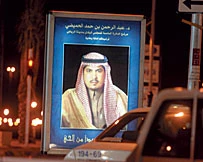
Clever candidates are also taking advantage of modern technology and have made their own home pages on the Internet where their platforms are displayed. Candidates have also turned to marketing and public relations companies to display their photos and names on advertisement boards near intersections or near traffic lights. This is very unfamiliar to a society which has little experience of elections and even less of election campaigns. Passing motorists, however, are puzzled not because this is a new phenomenon in Saudi Arabia but because the candidates’ faces are not shaded out. Usually in Riyadh if a person’s face is in an outside advertisement, it must be shaded out according to instructions from the Commission for Promotion of Virtue and Prevention of Vice.
One method used by nearly all candidates is to erect huge tents on empty plots of land where they can receive members of the public who want to ask them about their platforms.
The tent is usually large enough to accommodate as many as 200 people at a time. Guests are welcomed with dates and Arabic coffee. They are free to engage in conversation with the candidate and ask about matters that interest and concern them. They also receive brochures from the candidates’ associates. Dinner — usually a large feast of mutton and rice — is served later as part of Saudi hospitality. Since most members of the public are at work during the day, candidates use the evenings to welcome people to their tents. Some candidates have spoken to their contacts in the press and are holding press conferences in their tents to publicize themselves.
Saudi law currently forbids any candidate from speaking to television networks such as the local Saudi Channel One or Two or satellite television channels such as Al-Arabiya, Al-Jazeera and others.
Arab News spoke to Bandar Othman Al-Saleh, a candidate running for office in the sixth precinct, in his tent on Khurais Road.
Al-Saleh is a public administration executive and is a board member of several educational, sports, and non-profit organizations including, the Saudi Management Association, the Association for Disabled Children and the Saudi Arabian Olympic Committee. He is also the president of the Saudi Sports Federation for Fencing and the head of the Private Education Committee in the Riyadh Chambers of Commerce and Industry, as well as a member of the board of trustees of Riyadh Schools and the Othman Al-Saleh Philanthropic Cultural Society.
Some of Al-Saleh’s plans that he wants to implement are:
— Review Riyadh’s urban plan in order to diagnose the negative outcome of the city’s increase in population.
— Create a constructive and transparent relationship between the municipal council and citizens in terms of municipal services.
— Create mechanisms which can streamline complaints.
— Create local offices and branches of certain government agencies as may be required in certain districts and areas (decentralization).
— Spreading, improving and facilitating services for citizens.
— Providing services catering for people with special needs.
Al-Saleh commented: “Not long ago, I made a general survey of 1,000 people traveling in cars in Riyadh. I found out that the majority of cars which are in our streets and which cause most of our traffic jams are people traveling from one part of the city to another in order to get papers signed or work finished. There were people going to the Passport Department to get their passports renewed or to re-new an iqama for a maid or driver or employee; there were people going to courts to get their business finished and there were those going to specific government offices in certain districts. What I intend to do is to create branches or small kiosks of major government departments in neighborhoods. A citizen need not travel all the way to another part of the city to do official work. He should put all the necessary papers in a sealed envelope, get a number from the clerk, and then it either should be delivered to him or he can collect them later after they have been signed.”
Al-Saleh also spoke about the importance of families and children and the creation of more parks. “Currently many of our parks are in deplorable conditions. There is no maintenance on any of the facilities in them.”
He also noted: “I don’t see why a pregnant woman for example, needs to go all the way to Prince Abdullah Road to walk. Every district should have sidewalks where people can walk and exercise as they please.”
He also mentioned that Saudi society has still to recognize the needs of handicapped people and others with special needs. “None of our government or other buildings have facilities for people with special needs. Even the simplest thing — having car parks for the handicapped — is generally not available in our neighborhoods,” he said.