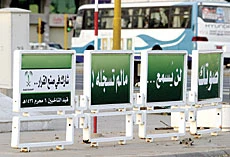
JEDDAH, 4 February 2005 — As the municipality gears up for the coming elections in Jeddah, the mood of residents in the city ranges from excitement to apathy.
Muhammad Al-Yami, the director of the media center for elections in Jeddah, was quoted by Okaz Arabic daily as saying that by next week all election centers would be provided with all needed equipment.
More than 300 employees are being trained for election centers across the city, from government schools and municipality offices to the conference hall at King Abdul Aziz University and the Public Administration Institute among others.
The local supervisory committee has announced the working hours will be 4.30 p.m. to 9.30 p.m. Saturday through Wednesday and on Thursdays from 9.30 a.m. to 2.30 p.m. The elections will proceed in a number of stages: The first is registration, which begins Feb. 15 (Muharram 6), and continues for a month. The second stage, which begins March 19 (Safar 9), will be when candidates register themselves over four days: March 20 to 24.
The preliminary list of candidates will be announced March 27 (Safar 17), and a final list of candidates will be announced April 9 (Safar 30). Then campaigning begins and continues until April 20 (Rabiul Awwal 11). Finally voters will cast their ballots in what many hope will be a historic election.
“I will be the first one to register my vote, and I will make sure that my voice is heard,” said Khaled Ahmad, a member of the local media. “I expect that registration in the Jeddah elections will be more than in other regions because more people are following the elections here.”
Ahmad said he knows what he is going to look for in a candidate.
“I don’t care if the candidate is a plumber or a businessman. What’s important is that they hold officials accountable for their actions. A candidate should make sure he fulfills the promises he makes. He must be responsible because he will be serving society — and he will be held accountable if he fails to do his job.”
Ahmad thinks the turnout will be large. “I believe that the elections in Jeddah will attract huge crowds and will succeed.”
Some think the elections will be a boon for business.
“I’ll vote for my friend who’s going to run as a candidate because I know that he is experienced in real estate and will benefit many people,” said Abdullah Al-Shubaili. “Most of the people who are running for election are real-estate people because real estate is the hot issue and the biggest and fastest growing business both in Jeddah and the Kingdom.”
Others say the elections are nothing but a waste of their time.
“I don’t know anything about the elections. I am neither going to participate in the election nor am I going to vote for anyone,” said Mansour Al-Harbi. “I don’t own land or real estate, and I don’t have any interests with the municipality. So how are the elections going to benefit me as an individual? Democracy is an idea that takes some getting used to. My voice is better not heard. I do not have any idea about the candidates. All I see is a bunch of people advertising themselves in the newspaper promising people that they will do something that I am not interested in because I have enough problems to deal with. Trust me, elections are the last thing on my mind.”
Al-Harbi is not alone in his views.
“I will not register to vote because I don’t care about the elections,” said Hamad Abu Khaled. “I also believe that connections and who-knows-who will be involved as well as personal benefits, so what’s the point? Elections or registering or voting aren’t going to earn my living, are they?”
But such apathy on the part of men who could vote is raising the hackles of women who can’t.
“Elections are about options and choice — the ability to choose,” said Fahda Al-Ghamdi. “Regardless of the results of the elections and the performance and production of the elected candidates or the ones running, this is the first time citizens are being invited to participate. Just by registering your name, you’re making a choice to be an active citizen who is willing to try. I honestly can’t understand this passive indifference men are showing.”
Some men who on their own might choose apathy may find they don’t exactly have that “freedom of choice.”
“We as women wanted to take part, and they said no,” said Umm Ahmad. “And those who are allowed to take part don’t bother? Changes will come by making a move. I’m encouraging all the men in my family to go and register when it’s Jeddah’s turn for the elections.”