
Generally speaking, the word tourism conjures fairly seam-free travel with facilities available that you wouldn’t get at home. The Farasan Islands certainly offer this; at home, for example, the shower works, the roof does not leak and very possibly you have a table to eat off.
If you want five star auto-flunkies pandering to your every need, then the delights of the Farasan Islands are definitely not for you. On the other hand, if you want to experience tourism as it probably was when the Baptist minister Thomas Cook first stepped out to organize a temperance tour in 1841, then they are the place.
Jizan Port, the embarkation point for transshipment to the islands is a sorry sight. Rusting hulks in the harbour, aged tugs and trawlers festooned with washing and pelicans plus long-abandoned tramp steamers tell a tale of “those who go down to the sea in ships” and then leave them there to rot when business drops off.
The tiny “passenger ferries” — a hyperbole for an eight-meter skiff with a plywood cabin and two enormous outboard engines hanging off the back — are the fastest way of covering the few kilometers between the port in Jizan and the one in Farasan. Document inspection for the trip is carried out by coastguard officials, languidly but politely rummaging through identity papers, giving the impression that it is more for something to do than for reasons of security. After much handshaking and “welcomes to Jizan,” we embarked from a greasy quayside onto the ferry, but not before one of the bystanders asked me to take a parcel of clothes to a Mr. Bafi at the Farasan Hotel. Touching trust in a total stranger, I thought; just as it used to be. I was glad to oblige.
We got our first taste of the concept of “involved tourism” that characterizes the islands when we were asked to sit at the back of the boat. The smiling pilot explained apologetically that only then would the engines reach into the water. Once we were moving and the craft leveled out, we were assured, all would be well. He was right of course as he makes the journey tens of times a week.
Driven with consummate skill, born of long practice by a couple of wiry Keralites, our ferry positively rocketed over slightly choppy sea through a couple of rain-squalls. The journey took precisely an hour, passing the ugly grey slab of the car ferry, looking much like a sea-going breeze block going somewhere. Reception at Farasan port was as fulsome as the departure from Jizan, Many hands assisted our disembarkation, and the paper formalities were handled with commendable dispatch. An assortment of vehicles from the general “taxi” whipped us smartly along extremely well-maintained roads to the Farasan Hotel.
We knew it was a hotel at once; it said so on the sign in large friendly blue letters. It is also the only one and contrasts starkly with the rough land it stands on by being almost completely covered with a rather sudden shade of pink paint.
Although we had booked well in advance I perceived a sense of delighted shock that we had actually turned up. Our group of ten filled almost all the rooms available and seemed to have caught the amiable Mr. Bafi on the front desk wrong-footed.
With impressive alacrity he had the paperwork and cash sorted out in less time than it took us to lug — and I pondered that this was the source of the word - the luggage through the doors.
Lunch was taken on the floor in a tent; the hotel does not run to a dining room and this meal, like most other meals consisted of chicken, fresh local fish and vegetables. None of the groaning buffets that go to waste in glitzier establishments here, just plain “un-messed-about-with” food, simply presented and fresh. The food at least had a table. Our own personal one arrived the following morning.
In the middle of the night, we were awoken by dancing on the ceiling accompanied by a tattoo of raindrops the size of golf balls and the synchronized shouting of frenzied workers sweeping the water off the roof of the single-story bedrooms. The explanation given by the redoubtable Mr. Bafi was simple. “It never rains here,” he said. “We are going to waterproof it later,” he added, smiling broadly. Nodding in a sign of total understanding and acceptance I asked him to arrange for the contents of my suitcase to be dried and the bedclothes changed. “No problem, sir!” It was said with such genuine goodwill and enthusiasm and an assumption that I had not minded in the least being soaked and entertained at 3.45 a.m. that on reflection, I actually hadn’t minded. That’s what these people do to you: Get you involved.
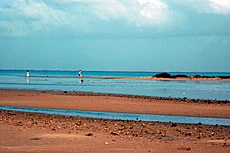
The eponymous “desert island” is much overrated; it’s a scrap of desert surrounded by water and it is also deserted. The Farasan Islands are largely low, flat topped lumps of coral, peering cautiously a handful of meters above the water. On the smaller islands, there are virtually no beaches; the odd sandy cove is usually the best you will find. The long tourist beach on the main island — and the one the guides enthusiastically show as the tourist beach — is several kilometers of clean white sand. A helpful picture on the coastguard shed near the shore sends a confusing message. Perhaps the message is: “Divers; please take all your corpses home with you.” You see what I mean? Tourism is still a bit raw round the edges. But bless them, they are trying very hard; the wordless notice is drawn with great effort and good intent!
That said, to find another place like this, largely untouched by anything more damaging than the odd fisherman and curious locals, you would have to travel a long way. One glance at these bleak islands would immediately send the sybarite scurrying 5-star hotel-wards in search of some pampering.
To discover what the islands are about, you have to get involved; get soaked in a bumpy boat ride on a bad day, scramble over wickedly sharp un-weathered coral rocks and hear the silence. When the wind drops, it is tangible.
To wander on the larger beaches on sands with only animal tracks and the occasional flock of flamingoes peering cautiously at you from the shallows is to walk on the edge of the world. Otherwise nervous sandpipers stroll casually away from your approach, disdaining flight. It is simply magical - classic recherche de temps perdue.
The Farasan Islands are an archipelago of scores of islands, but few are inhabited. The entire group has a population of only 16,000, most of whom live on the main island. Any fame the islands have is for their virtually untouched marine life — threatened now by visiting and illegal scuba-equipped spear fishermen from Saudi Arabia — and crystalline water.
However, for even the casual or inexperienced snorkeller, there is a treat in store. Shallow reefs cluster round the rocky edges of the islands in water only a few meters depth. The abundance of coral and the variety of marine creatures that live in symbiosis with the reefs exceeds even the very good examples found off the Jeddah coast.
The clean water means that snorkellers can clearly see even the small exotic creatures clearly. The scuba diver is in for a real treat. The local boat drivers from the quay near the hotel know where the best spots are.
Bleak they may be to look at, but closer inspection reveals the history of the archipelago. Located a few kilometers north of the Yemeni border and near the main sea routes of the Red Sea, the islands’ strategic potential has been obvious to generations of occupiers.
Standing slightly outside Farasan town on a rocky outcrop is a Turkish fort of mid-nineteenth century vintage, constructed from locally mined coral blocks.
In Farasan itself, the Turkish governor’s residence still stands, now occupied by a welcoming family who were delighted to show us the remarkably well-preserved stuccowork and decoration. They explained that they could have pulled it down and rebuilt but chose to preserve it and live there instead. Now it has been designated an architectural site by the Ministry of Antiquities: living history at its best. On another of the islands is a fort from a different era. Constructed during WWII, it was a German base for monitoring activities in the Red Sea. Emulating the local traditional architectural style, the fort is both camouflaged and in harmony with the other, far older structures in the area. Returning to the mainland by the same ferry in the failing evening light, the Farasans gave us a parting glimpse of their “big skies.” For some reason, possibly because the islands are so low and flat, the skies and their mackerel pattern clouds seem that much bigger. The red ball of the sun quenching itself in a glassy sea was a spectacular farewell to a destination mercifully unattractive to the five-star traveler.