JEDDAH, 11 February 2005 — Two archrivals in Pakistani politics who are both former premiers in exile buried the hatchet yesterday in a watershed meeting in Jeddah and agreed to work together in what they called the larger interest of democracy.
Political sources said Benazir Bhutto and Nawaz Sharif resolved to share responsibility to take Pakistan out of the present political quagmire. Their parties — Pakistan Muslim League-Nawaz and Pakistan People’s Party — are the country’s major democratic powerhouses with nationwide popular appeal.
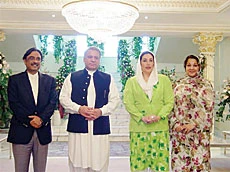
Benazir, who arrived here late on Wednesday night, was accompanied by her husband Asif Ali Zardari and Sen. Farooq Naik when she visited Sharif at his Suroor Palace residence in Jeddah’s Ruwais district. Their meeting lasted about four hours.
The two opposition leaders agreed that Pakistan, “a federation created for democracy through a democratic struggle, can only become strong and developed through people’s participation and genuine democracy.”
Benazir and Sharif said Pakistan “must revert to real democracy and restore the 1973 constitution as soon as possible through fair, free, and transparent elections under an independent and effective election commission.” Their parties will cooperate and work together at every level to achieve “this sacred goal.”
As leaders of Pakistan’s largest parties, they affirmed their faith in the collective will of the people and assured Pakistanis that the two will make a fresh start toward “ushering a new era of democracy based on mutual respect, tolerance, human rights, including the rights of women, minorities and the under-privileged, besides promoting prosperity of all people without discrimination.”
They pledged that the PPP and PML-N will work toward defeating any attempt to create rift and differences in their ranks.
Until now, the parties were diametrically juxtaposed in the country’s political spectrum — a phenomenon that cost both parties dearly over the turbulent past.
Benazir and Sharif resolved that they would not act in any way that would help non-democratic forces to negate the 1973 constitution which guarantees people’s democratic rights, supremacy of Parliament, independence of judiciary, rule of law, freedom of media and the prevalence of the will of the people.
Both leaders also promised to restore good governance coupled with self-respect and dignity. They called upon all political forces in the country to agree on a “charter of democracy” which should become the cornerstone of a movement to “end dictatorships for all times to come.” Differences on policies and other issues should be set aside for achieving this common goal, Pakistani diplomatic sources added.
Both parties agreed to form working groups to outline specific measures and reforms for implementing the charter of democracy.