
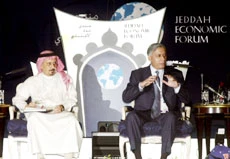
JEDDAH, 20 February 2005 — Pakistan Prime Minister Shaukat Aziz yesterday called on Saudi Arabia and other Gulf Cooperation Council (GCC) states to invest liberally in Pakistan.
Addressing the 6th Jeddah Economic Forum (JEF) at The Jeddah Hilton, the Pakistani premier said: “Our economy is moving in the right direction. The Pakistan of today has effected a complete makeover. It has a new face, winning the hearts and minds of the international community while facing up to the twin challenges of globalization and economic prosperity.”
In his address, “Transforming a Nation: Early Challenges, Obstacles and Successes,” Aziz said: “Pakistan offers immense investment opportunities. It is a market of 150 million people with a growing middle class. It is not only a growing market but is emerging as a regional powerhouse. It is also emerging as a trade and manufacturing hub that connects North Asia, Central Asia, West Asia and the Middle East.”
Aziz also said that over 600 multinationals are already operating in Pakistan with an average profitability of more than 25 percent. All economic sectors are open to foreign investment and Pakistan has allowed up to 100 percent foreign equity with remittances of profit, dividends, royalty and technical fee allowed to transfer and foreign private investment is fully protected.
Aziz also focused on the exemplary relations that Pakistan has enjoyed with Saudi Arabia consistently over the years. “Pakistan’s relations are characterized by cordiality, brotherly warmth and mutual trust. The two countries have an abiding interest in each other’s security.”
He said the global economy was adjusting to a new environment — an environment in which oil prices have risen to an all-time high because of demand as well as supply constraints. The dollar is weakening due to the increase of US current account deficit and a rising inflation fueled by food and energy prices as well as rising interest rates which reflect a gradual tightening of monetary policy. The world economy registered an average growth rate of 4 percent — with strong growth in industrial countries and exceptionally rapid expansion in emerging markets, notably China.
This means the world economy is doing a much better job of absorbing shocks caused by multidimensional forces, including the unprecedented rise in oil prices. It also signals that the era of cheap energy is over; in other words, the oil price floor has risen because of the growing demand - a reality that all oil consumers will have to accept. The time has come for policymakers in oil importing countries to review their energy policies carefully, focusing on conservation, efficient use and developing alternative energy sources.
Aziz said Pakistan was witnessing a massive surge in economic activity, not seen in many decades. The confidence of domestic as well as foreign investors is soaring to new heights on the back of a stable macroeconomic environment. Wide-ranging reforms, prudent macroeconomic policies, financial discipline and consistency and continuity in policies over the past five years have transformed Pakistan into an exciting and resurgent economy.
Aziz added that the external balance of payments has never been so comfortable; the current account balance is in surplus and foreign exchange reserves are now sufficient to provide cover for 9 months of imports. Pakistan’s exchange rate is stable; the budget deficit has been reduced to below 3 percent of GDP; the country’s debt burden has not only declined sharply but is fast approaching a sustainable level.
Pakistan has prepaid expensive external debt and both Standard & Poor and Moody’s have upgraded Pakistan over the last five years. Aziz also said Pakistan had also made a successful return to the international capital market through the flotation of a $500 million Eurobond in February 2004 and $600 million Islamic bond (sukuk) in January 2005 on the back of an exit from the International Monetary Fund program. Both the transactions were oversubscribed several times, reflecting a huge vote of confidence by international investors in Pakistan. He emphasized that Pakistan had laid the foundation of a stable and strong economy and the stage is now set for the economy to grow more vigorously (8 percent per annum) over the next several years with the private sector playing the lead role.
Structural change is the essence of development, Aziz said. “Reform is a dynamic concept. The country must continue to adjust itself to changing domestic and external environments. Over the last five years these reforms have begun yielding results in terms of improved macroeconomic environment and acceleration in economic growth. To achieve a 7-8 percent growth, Pakistan will introduce what we call second generation reform.”
Over the next five years Pakistan’s reform agenda will concentrate on strengthening institutions, improving the competitiveness of industries, building a robust financial system in an environment of global financial restructuring, further restructuring of tax administration, promoting transparency in economic policy-making and strengthening the country’s physical and human infrastructure.