RIYADH, 22 February 2005 — The Kingdom said yesterday it was keeping a surplus oil production capacity of up to two million barrels per day (bpd) to meet unexpected world demand.
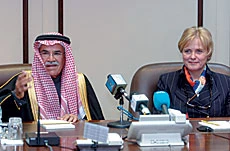
“We always maintain a surplus (production) capacity of 1.5 million to two million bpd in order to meet unexpected demand, such as happened in 2003 and 2004,” Oil Minister Ali Al-Naimi said after talks with visiting Norwegian Petroleum and Energy Minister Thorhild Widvey.
The two ministers discussed yesterday the oil market situation, especially demand and supply, prices, international reserves, and the future production program of the two countries.
Widvey with her team provided a summary of their exploration and production and their new exploration activities for oil and gas.
Asked about how Saudi Arabia is going to meet the growing demand for oil in the global market and at what cost, Al-Naimi said that the Kingdom has always been able to maintain an additional production capacity of 1.5 million to 2 million barrels per day.
“That is why we are sure we will meet most of the reasonable demands of the world,” he said.
Answering a question about Saudi oil reserves for future generations, the minister said: “When we intend to expand our production, we also take into account the approximate life of oil fields which ranges from 50-100 years. So there is good reserve for the next generation,” he said at a joint press conference with the Norwegian minister.
On the question of costs, Al-Naimi said that additional reserves mean more costs and since this is an energy the world needs, and is willing to pay for, it is “good business for the producer and the consumer.”
Al-Naimi said that there are many new oil fields such as Manifia, which is a very huge field, and Khurais, which has barely been touched in the past and has an idle capacity of 50,000 bpd.
“I believe we have between oil and gas over 80 fields and we are producing from less than 20 fields a day,” he said.
“We do not need Manifia to reach the capacity of 12.5 million bpd. There are so many small fields that may increase the capacity beyond 12.5 million barrels.”
He said that today 90 percent of Saudi oil rigs are not owned by Saudi Aramco.
Replying to a question on whether Norway would be joining OPEC and the country’s possible areas of cooperation with the Kingdom, the Norwegian minister said she was visiting the Kingdom to have a good conversation on the market and market situation.
“We will not be joining OPEC and I do not see it in our political agenda in the future,” she stressed.
She said that her delegation consisted of representatives of the Association of Norwegian Oil and Gas Partners to work on better cooperation along with Norwegian companies working in the Kingdom.
About the areas of cooperation between Saudi Arabia and Norway, Al-Naimi said that both countries are major producers and major exporters, and both have extensive experience in oil and gas production, as well as exploring gas and oil.
“We have a joint technical committee that goes in great details on progress areas both in production facilities in Norway and Saudi Arabia,” he added.
“We also have a very good relationship with Statoil company in the R and D area. These are the things we benefit from besides working together at stabilizing the oil market and assuring supplies to the international market.”
Asked about oil pricing, supply and demand of the market, Widvey said, “For Norway it is important to have a price at a reasonable level which should not be so high as to damage the world economic growth”.
She said that that prices should be attractive especially because of the climatic and environmental challenges in the North Sea and Artic Ocean.
Widvey declined to give a specific figure on what she believed was a “reasonable price” as it was “too difficult to say where it should be.” However, she believed “ it is going to stay at a high level.”
About the possibility that the world can live with $50 per barrel price and whether Al-Naimi agreed with that, the minister replied that the Kingdom, as a producer, does not set prices; it is a price taker. The market determines what the price is, he said.
“What we producers are interested in and are trying to prevent is the volatility of the market. And that is why we do our utmost to reduce the movements in price. What we — producers or consumers — are concerned with is the sudden movements in price.”
Al-Naimi said OPEC in its next meeting in March will recommend on the new mix for OPEC basket to decide a reasonable band of price for the organization.
Saudi Arabia had a target to add 5 trillion cubic feet to its actual gas reserve, however, it succeeded to add 7.5 trillion cubic feet to the gas space.
“The Kingdom is consuming 7.5 billion cubic feet and has to satisfy the huge demands of the chemical, mining, and other industrial requirements which will be around 12 to 14 billion cubic feet in the year 2025,” Al-Naimi said.
He said that “Saudi Arabia is presently producing 9 billion bpd. We have a program to increase our production capacity to reach 12.5 million barrels a day by 2008-2009.”