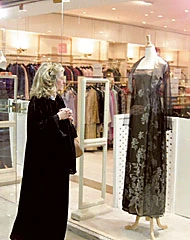
JEDDAH, 5 July 2005 — Most shopowners and salespeople are not overly enthusiastic about establishing shops staffed by Saudi women that sell women’s clothing and personal items. They say the Labor Ministry’s new directive which mandates hiring Saudi saleswomen in women’s shops will create problems rather than bringing about a solution to the cultural issue of making women’s wear the exclusive domain of women — for and by women.
Last week the Labor Minister, Dr. Ghazi Al-Gosaibi, issued a directive that all employees in shops selling women’s lingerie and clothing should be Saudi women. The decision gave lingerie shops a year in which to employ Saudi women while other shops selling women’s clothing were given two years to implement the directive. The directive also called for shop-owners to design their shops so those outside cannot see inside; this will prevent any interaction with men. Shops must also have special entrances for women only. This most recent directive follows an earlier — and contradictory — one by the Labor Ministry in which lingerie shops were told to Saudize by hiring Saudi males.
In a survey of Saudi women, 85 percent of those questioned liked the idea of working in a women’s only shop or a women’s only department. Sixty percent, however, stated that they would consider such a job as a start and wanted to know whether working as saleswomen would include promotional opportunities such as are open to men.
The labor minister’s announcement caught nearly everybody by surprise. Many shop owners termed this unheard of idea as impractical for both technical and cultural reasons. Even men and women — professionals and nonprofessionals — agreed, saying that in trying to solve one problem, the ministry introduced many new ones.
“Women replacing my salesmen?” exclaimed Saleh Al-Jihaini, manager of Laylaty for Fashion, a women’s clothing store. “Impossible! Such an idea is easy for the minister to expound but is it practical when it comes to carrying it out? It is going to cost us and cause so much trouble. I’ve personally trained the men in my shop. I’ve never dealt with women, let alone having them work for me. What a headache that will be!”
In a survey including shops selling women’s products ranging from lingerie to make-up, abayas to shoes, Arab News found that 89 percent had received no official document or notification from the Labor Ministry.
“A friend of mine mentioned reading something like this last week,” said Faisal Abdul Rahman, a salesman in a shop selling abayas. “But we’ve received nothing from the ministry about this or that there’s a deadline we’ve got to work toward.”
“How can the Labor Ministry make such a decision without informing those affected by such a move first?” said Sulaiman Ahmad, owner of Azyaa, a shop selling women’s clothing including lingerie. “We’ve heard nothing from any labor office about such a thing. We should know first, shouldn’t we? Such a matter is going to affect our lives, our businesses!”
The survey by Arab News also revealed that 94 percent of salesmen and shop managers agreed that women should be employed in lingerie shops while 83 percent considered the women’s only move an impractical idea for different reasons.
“Saleswomen working in lingerie shops is a good idea; after all, I don’t think any man would want to buy his underclothes from a woman,” said Sameer Howsawi, a salesmen in a women’s clothing shop.
“And I think most of us men would prefer that our women buy such things from other women. But employing women in all stores selling women’s clothes? Is that possible in our country?”
“Is Dr. Gosaibi going to ruin us like he did the gold shop owners, managers and salesmen when he Saudized the gold shops?” asked Ahmad Al-Ghamdi, a recently-employed salesman in Al-Shoroog store for women’s clothing. “This is even harder than Saudization; it’s not about nationalities, it’s about genders — and some of the hardest lines to cross here are lines related to gender.”
“Why didn’t they let women take part in the elections? Why aren’t they letting them drive?” continued Al-Ghamdi. “Let’s be honest — they didn’t and they don’t because it’s all about Saudi women being out in the open, in public. People don’t want it, the culture won’t accept it so what’s the difference between letting women drive or having them working in shops that are on the public streets?”
Many found the necessity for shading or blocking shops windows where saleswomen work to be impractical. “Women make up the majority of average customers, meaning that most stores must have saleswomen because the customers they serve are females,” said Fayez Mohammad, a manager of a local store selling women’s clothes. “Are we expected to cover and shade three quarters of the market? It’s not realistic at all. What about the window displays in our shops? How are we supposed to manage that with windows that block customers from looking in? It doesn’t take a consumer experts to tell you that window displays play a big role in attracting prospective customers!”
“And what about men who shop with their wives?” asked Suhail Mohammad, Fayez’s brother and business partner. “Not all women shop on their own with drivers, you know. Will women be going into the shops while their husbands wait outside?
Is this a solution to bring things together or drive things apart? And are there so many Saudi women who want to be saleswomen? Especially in some parts of the country many families wouldn’t hear of their daughters, sisters or wives working as saleswomen. Come on, how long was it until the idea was accepted by Saudi men?”