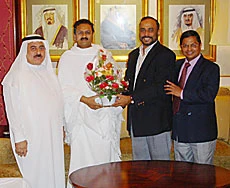
JEDDAH, 8 July 2005 — He is one of the most powerful ministers in Andhra Pradesh’s Congress Party-led government. With direct access to Chief Minister Y.S. Rajasekhara Reddy, Information and Public Relations Minister Muhammad Ali Shabbir’s political prestige and power is great indeed. In addition to this, he is also the chairman of the Andhra Pradesh Non-Resident Indians Cell (Study Group) and is working hard to build a bridge of understanding with the large Andhra Pradesh expatriate community in the Gulf states, especially in Saudi Arabia.
Muhammad Ali Shabbir is a no-nonsense politician and a grass-roots leader who won the historic May 2004 assembly election with a record margin from Kamareddy district in Nizamabad. That election saw a stunning reversal for Telugu Desam Party’s Chandrababu Naidu and a spectacular victory for Sonia Gandhi’s Congress Party.
In a telephone interview with Arab News from the state capital, Hyderabad, before his arrival in the Kingdom on Wednesday, Shabbir said his government’s decision to provide a five percent reservation for Muslims in educational institutions and employment has provoked comment and interest throughout the country.
“YSR has become the biggest hero of Muslims in India. We have become a role model for all state governments in the country. There is a tangible sense of empowerment among Muslims. It sets a precedent for other secular governments to follow. This was our promise in the run-up to the May 2004 elections and we have implemented it in letter and spirit,” he declared.
According to Shabbir, the decision to give a five percent reservation to Muslims in educational institutions and employment was taken after careful consideration of the recommendations made by the Commissioner of Minorities Welfare. The study by the commissioner said that socioeconomic conditions in the state’s Muslim community were very bad due to poverty, illiteracy and inadequate representation. According to the 1991 census, the minority population in Andhra Pradesh was 7.2 million, constituting 11 percent of the total. Some 6.4 million of that number were Muslim which accounts for 8.5 percent of the population. The survey revealed that about 65 percent of Muslims were living below the poverty line. The literacy rate among Muslims was only 18 percent as opposed to 44 percent among other communities in the state. Among Muslim women, it was only four percent. The study also said that most Muslims were engaged in small businesses or making a living as rural artisans.
Shabbir said as a result of the new reservation policy, 175 Muslim students will receive free medical education and there will be 4,750 Muslim engineering students. There will also be hundreds of jobs in government institutions. “Our government also appointed a Muslim vice chancellor (Professor Sulaiman Siddiqui) for Osmania University after many years. The last vice chancellor was Hashim Ali Akhtar and that was nearly 20 years ago. Our party has also taken steps to appoint Muslims to agricultural committees across the state. We want to give a genuine sense of empowerment to Muslims, not only in the city of Hyderabad but in all the state’s villages as well.”
He said during the administration of Chandrababu Naidu, Muslims were repeatedly told that they should be grateful there were no communal riots. Shabbir pointed out, however, “We have not only provided peace and security for the community but also jobs.” He said his government had taken great care with all sections of society. “The youngsters are happy because of the jobs that we have created. The Dalits are happy with the number of houses the government is building for them; the farmers are happy with our decision to provide free electricity to them. The stability of this government should never be in doubt. The forthcoming municipal elections will prove our popularity.”
Shabbir said Naidu had created a lot of name for himself among expatriate communities all over the world but he had never given a thought to NRIs in the Gulf, especially in Saudi Arabia. “Our government has created an NRI Study Group and I am its chairman. After becoming chairman, I visited Kerala to study the kind of facilities they were extending to non-resident Keralites who are referred to as NRKs. The first thing that we focused on was education for the children of expatriates. We decided to take Osmania University to the Gulf. Children of expatriates will thus be able to pursue higher studies without moving to Hyderabad or any other city in Andhra Pradesh. This is our first big achievement.
“Secondly, we asked all insurance companies in India to come up with a special package for NRIs and their dependents in India. This will result in a huge sum for the returning NRIs... They will receive a substantial sum at the end of their careers in the Gulf. The modalities of these insurance schemes will soon be announced and the government will publicize these schemes through its various publicity arms.”
Shabbir said expatriates would be wise to invest in projects approved by the state government. “My advice to them is not to invest money in Al-Falah or Al-Salah or whatever. Their money is precious and they should not let it slip away,” he said. “They can invest in projects such as the new Singapore City and Malaysian projects in which the government has nearly 26 percent stake. Let the expats invest on behalf of the government. That would be a secure investment.”
He said the chief minister attached great importance to ties with Saudi Arabia and would visit the Kingdom in September. He praised Indian Consul General Dr. Ausaf Sayeed who, he said, had added a new dimension to ties between Andhra Pradesh and Saudi Arabia. “He has brought Saudis, and especially Saudi businessmen, closer to Hyderabad,” he stated.
Shabbir said he had little patience with NRIs who seem to think that forming a committee is the thing to do. He refers to these people as “business card NRIs as they all have business cards. They telephone me and say, ‘I am so and so. I am chairman of this or that committee.’ When I ask them what their proposal is and to please send it to me, there is no response. This kind of thing should stop and people should engage in doing something constructive.”