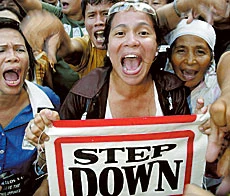
MANILA, 10 July 2005 — Gloria Macapagal Arroyo’s presidency was in tatters yesterday, her base of support eroding by the hour, as former backers abandoned the Philippine leader and added to calls for her resignation over an election scandal.
But in a radio address as thousands of people protested against her in Manila’s financial district, Arroyo defiantly vowed not to quit, said she would name a new Cabinet next week and told her opponents to take their complaints to Congress.
Arroyo repeated her offer to undergo an impeachment process, telling her opponents they should follow proper procedure and take their case to Congress, where her administration holds majorities in both houses.
“In the meantime, I will continue to focus on the people’s business, which is getting our economy moving and creating better quality of life for our people,” said Arroyo, who insisted that she did not cheat.
However, she appeared to be barely holding on, with prospects rapidly fading for anything other than a peaceful handover of power to Vice President Noli de Castro, who leftist groups said must show that he’s not tainted, too. De Castro said he was asking Arroyo to decide what’s best for the country and he urged the people against taking the law into their hands.
Troops and police went on full alert in the capital and soldiers were warned against taking sides.
Authorities warned against rowdy protests in an effort to pre-empt a repetition of “people power” revolts that have ousted two presidents in the last two decades. But left-wing and opposition groups ignored the warning, and gathered along Ayala Avenue, a key thoroughfare in Manila’s Makati financial district, calling for Arroyo’s resignation.
“She’s digging in,” said opposition Makati Mayor Jejomar Binay, who led the protests. “But we will not stop until she steps down.”
The flag-waving crowd, chanting “Arroyo resign” to the beat of disco music, grew to about 5,000 and then began dispersing at nightfall.
Some marched toward a “people power” commemorative shrine to join an anti-Arroyo group holding a prayer vigil.
Former President Corazon Aquino, who failed to get Arroyo during a meeting on Thursday to quit, called a press conference yesterday and publicly urged her to resign, saying the country can’t afford another “people power” revolt like those that carried both of them to power.
Aquino had been one of Arroyo’s biggest supporters, but said an ongoing crisis over allegations of election fraud was hurting the Philippines and that a constitutional handover to the vice president was needed to restore stability.
“I ask the president, in all humility and with full awareness of its difficulty and pain, to make this supreme sacrifice to spare our country from the violence that threatens it from those who seek in her lapses of judgment, not a reason for reform, but an excuse to subvert the constitution, grab power and destroy our country,” Aquino said.
Aquino, who succeeded late dictator Ferdinand Marcos after massive “people power” protests in 1986, said Arroyo had two constitutional choices: Voluntary resignation and a smooth transition of power to the vice president, or a “long and inherently contentious” impeachment process, which Aquino said could only generate more divisions.
“I ask the president to spare our country and herself from the second option and make the supreme sacrifice of resigning,” she told reporters, reading from a prepared statement.
Mrs. Aquino said Arroyo’s qualities as president “were acknowledged by her most important Cabinet members when they resigned today, because it is no longer possible for her to govern and for them to do their work.”
Arroyo, due to serve until 2010, had also been pumelled with that her husband, son and brother-in-law took kickbacks from illegal gambling.
Arroyo’s husband, Mike, left for the United States on “self-exile” early in the week in a bid to take away the heat from the president.
But 10 of Arroyo’s key officials, including seven Cabinet secretaries, who resigned said allegations that she rigged the May 2004 ballot had eroded her capacity to govern. They urged Arroyo to make the “supreme sacrifice” by stepping down and relinquishing her position to Vice President De Castro.
Finance Secretary Cesar Purisima read the group’s statement titled “Of Leadership and Credibility.” The others-Social Welfare Secretary Corazon “Dinky” Soliman, Education Secretary Florencio Abad, Budget Secretary Emilia Boncodin, Trade Secretary Juan Santos, Agrarian Reform Secretary Rene Villa, Presidential Adviser on the Peace Process Teresita Quintos-Deles, National Anti-Poverty Commission Chair Imelda Nicolas, Internal Revenue Commissioner Guillermo Parayno and Customs Commissioner Alberto Lina-sat in silence.
“The longer the president stays in office under a cloud of doubt and mistrust, and with her style of decision-making, the greater the damage on the economy and the more vulnerable the fragile political situation becomes to extremists seeking to undermine our democratic life. In the end, the poor will suffer the most,” said a joint statement of the Cabinet officials who resigned.
Businessmen, Bishops
Later in a joint briefing at the Peninsula Manila, the Makati Business Club (MBC) and Financial Executives Institute of the Philippines (Finex) said the resignation of the Cabinet officials “illustrates the loss of confidence in the president and her ability to advance economic and social development programs.”
They said Arroyo should resign “for the sake of national unity and for the sake of moving forward.” A coalition of civil society groups echoed the call.
Even the influential Catholic Bishops Conference of the Philippines (CBCP) is preparing to call for the president’s resignation.
Senior Catholic bishops led by Manila Archbishop Gaudencio Rosales held an emergency meeting Thursday night to discuss options to end the worsening political crisis, according to two Church officials privy to the meeting.
The sources said Rosales and at least four other prelates-Cebu Archbishop Ricardo Cardinal Vidal and Bishops Socrates Villegas of Balanga, Antonio Tobias of Novaliches and Chito Tagle of Imus-had agreed that the best option was to call for Arroyo’s resignation through an official statement by the CBCP.
“The most preferential option during the meeting was to tell the president to make the ultimate sacrifice for the common welfare,” one of the sources told the Inquirer.
Envoy, Liberal Party
The Philippines’ ambassador to China and former vice president also resigned yesterday in apparent withdrawal of support from Arroyo.
“It pains me to write this letter, but the challenge that confronts the nation today goes beyond personal attachments,” Teofisto Guingona, who previously served as Arroyo’s vice president, said in a letter to her. “We decide as conscience dictates.”
One of the most critical withdrawals of support came from the Liberal Party (LP), a key partner in Arroyo’s ruling coalition and headed by Senate President Franklin Drilon.
“The Liberal Party is appealing to the president to vacate her office by way of a voluntary resignation. Should she decide not to resign, the LP will support an impeachment process,” Drilon said in a press conference.
He added that “this painful and difficult decision was taken after an intensive analysis of the unfolding events, a series of consultations with the members of the party including the advisory vote to guide the party’s executive committee.”
Impeachment
Two impeachment complaints have been prepared against Arroyo, whose majority in the lower house of Congress is likely to quash any attempt to oust her.
Ramos has proposed a change in the two-house congressional system that would see Arroyo stay on as caretaker president until fresh elections for a single parliament in May 2006.
Arroyo, who said on Thursday the political system required fundamental change, has made no secret of her own desire to move to a parliamentary system to speed up passage of laws.
In urging her foes and critics to take their case to Congress, Arroyo warned: “This is a democracy that’s held together by the constitution and the rule of law. The Philippines has fallen into a dangerous pattern where the answer to every crisis is to subvert due process rather than work within the system,” Arroyo also warned in a statement.
“She’s the last stumbling block to reforms being achieved in the country,” Francis Escudero, who leads the opposition in the lower house, said on the ANC television channel.
Some analysts said financial markets would have liked Arroyo’s main economic managers to stay on to steer reforms aimed at improving weak revenue collection and cutting debt of nearly $70 billion.
The peso neared its historic low against the dollar before recovering to close at 56.10. Bonds slumped but stocks rose, with analysts expecting any leadership change to be peaceful.
Under the constitution, Vice President Noli de Castro would assume the presidency if Arroyo resigned. The president should be given “a chance to think,” De Castro said.
“Even a swift Arroyo resignation would be unlikely to settle matters as Vice President de Castro has questionable support among the elite,” David Fernandez, research head for Asian emerging markets at JPMorgan, said in a note to clients.
US Embassy
In a further blow to Arroyo, the top US diplomat in the Philippines yesterday commended the Cabinet officials who quit, calling them “patriots.”
US Embassy charge d’affaires Joseph Mussomeli dismissed claims by some of Arroyo allies that the resigned officials were “adventurists.”
“I know many of those Cabinet members who have resigned now and the ones that I know are all very decent and good people, patriots, who are concerned with the welfare of the Filipino people,” Mussomeli said on ANC network.
“Not the ones I know. No, I couldn’t agree with that,” Mussomeli said. “I know some of them very well. The ones I know, frankly, have accepted these posts as an act of patriotism. They could make a lot of money and have a lot more prestigious roles in the private sector but they have chosen to be in the Cabinet,” he said.
He also made it clear, however, that the United States would “firmly oppose” any effort to unseat Arroyo by extra-constitutional means, including by coup or by “People Power” protests.
Mussomeli, whose government had hailed Arroyo as a staunch ally in its fight against terror, evaded any direct answer when asked if he could categorically say that the Washington still supported the Arroyo administration.
Mussomeli indicated his dismay at how the country’s leaders had embroiled themselves the past few weeks in the struggle to keep or seize power.
“I would only say, and maybe I am getting too personal on this and I shouldn’t as a diplomat, but it seems that the focus on both sides is too much on either retaining power or attaining power and not enough focus on the Filipino people and what’s best for them.” (With input from Inquirer News Service and The Associated Press)