
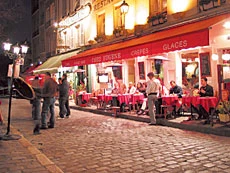
It is a quaint but a characteristic way of seeing themselves that the residents of Montmartre see Paris as connected to their ancient quarter rather than the other way about.
Located in the northern half of the city on the Rive Droite (right bank) of the River Seine in Paris, many would agree that Montmartre is the place where art in France truly began; a visitor to the area reads the long history of the quarter written in the building and streets, as if in a book that was first drafted by the Romans, whose empire dominated the area around 55 AD.
Like most names of areas and streets in Paris, that of Montmartre has its history. One tale says it was originally called “Mont Marat” during the Revolution to commemorate the assassinated revolutionary Jean Marat. However, the medieval bestseller “The Golden Legend” by Jacobus de Voragine narrates the story of the first bishop in Paris, Saint Denis, a missionary sent by the Christian Church of Rome in 250 A.D. to convert the Roman pagans in Paris.
Saint Denis was not well received by the local authorities and was sentenced to death by the then Paris governor Sisinnius Fesceninus. The execution was to take place at the summit of the highest hill in Paris in the Temple of Mercury and according to legend the decapitated Saint Denis picked up his head and walked six kilometers uphill to 9 Rue Yvonne-le-Tac where he washed his bloody head. Before Saint Denis died, a woman converted in front of him; later the same woman buried him in a Christian ceremony. As a result of the legend of Saint Denis and the slaughter of other Christians on that spot, the hill became Montmartre or “Mount of Martyrs.”
Montmartre is home to Sacré-Coeur, one of the most identifiable buildings in Paris. The Basilica of Sacré-Coeur with its white dome was erected between 1876 and 1912. Two sculptures of Saint Denis and Saint Genevieve adorn the entrance of the church and Parisians believe these two saints are the protectors and heroes of the city. Saint Genevieve was honored because she prevented the attack of Attila, the most successful barbarian invader of the Roman Empire in Paris. During his siege of Paris, Saint Genevieve put her life in danger by passing the siege lines around the city in a boat in order to bring grain to the starving citizens.
The long and eventful history of the city also harbors the birth of art and its introduction to France. Famous artists — Toulouse Lautrec, Picasso, Degas, Van Gogh and even Leonardo da Vinci have all lived in Montmartre for all or some of their life. This is where Picasso painted his fist cubist work, “Les Demoiselles d’Avignon.” “Lapin Agile”, Picasso’s painting of a small bar in Montmartre, was sold in the 1980s for nearly $50 million and is now on display at the New York City Metropolitan Museum. The bar used to be called “Les Assassins” after a painting that showed a serial killer who killed the bar owner’s son. This watering hole was famous for the impromptu performance of traditional French songs and sing-a-longs and a cabaret. The painter Bronali, whose success was abruptly put to an end when it was discovered that the secret behind his interesting paintings was that he produced them by tying a brush to a donkey’s tail, was a frequent visitor. Artistic skills aside, tourist guides agree that Bronali was a master of invention.
Leonardo da Vinci was also amongst those who chose to live in Montmartre. Many of da Vinci’s paintings were sold to the French and today the famous La Gioconda, or ‘Mona Lisa’, can be admired at Le Louvre, Paris most famous art museum. Da Vinci was put to rest in the cemetery of Montmartre.
A steady stream of painters has continued to trickle through Montmartre. Just a few steps from Sacré-Coeur, is the ‘Place du Tertre’ where artists work around the clock. These painters are searching for faces, impressions or thoughts for inspiration to keep them their drawing going. Many tourists sit to have their portrait done while enjoying a cup of coffee and a gateau.
Agriculture too has its place in the history of Montmartre. The area boasts the only remaining vineyard in the city. Montmartre used to have between 15 and 30 windmills and today only two remain, “Le Moulin Rouge” and “Moulin La Galette”. The former became famous when its owner defended it against the Prussians, German inhabitants of Prussia. He was unfortunately caught and hung on the sails. “Moulin La Galette” was named after la galette (a cake made from flour ground inside the mills).
The final stop on a tour of Montmartre should be the bust of Dalida. Yolanda Gigliotti — who was called Dalida — is a famous 20th century singer and comedian.
Montmartre is destined to be the setting for more amazing stories as time passes by. Every corner and every street holds the memory of something or someone that can make hearts beat with excitement. It could be true or it could be a legend and if there is nothing there yet, you can create your own memories. Paris is a city in which everything can be lived, some of which will be remembered, some forgotten.