WASHINGTON, 20 July 2005 — Indian Prime Minister Manmohan Singh is a man on a mission: He wants US support for India’s civil nuclear program..
In Washington yesterday, he assured members of the US Congress that his country would not share sensitive technology. This followed President Bush’s promise Monday to help India develop its civilian atomic sector, which would require congressional support.
“The field of civil nuclear energy is a vital area for cooperation between our two countries,” Manmohan said, describing India’s track record on nuclear nonproliferation as “impeccable.”
The prime minister said India had “adhered scrupulously to every rule” even though “we have witnessed unchecked nuclear proliferation in our own neighborhood which has directly affected our security interests” — an apparent reference to Pakistan, its neighbor and longtime rival.
“We have never been, and will never be, a source of proliferation of sensitive technologies,” he said, to applause from lawmakers.
Manmohan said the objective of his trip was “to lay the basis for transformed ties between our two great countries.”
Those ties, he said, included new cooperation in the fight against terrorism, combating AIDS, promoting democracy and developing energy resources, including nuclear power.
Manmohan’s speech marked only the eighth time a foreign leader has addressed Congress in the past five years and the first by an Indian leader since former Prime Minister Atal Behari Vajpayee in 2000.
His visit marks a warming of relations between the two countries, which for most of the last 50 years maintained a frosty relationship. During the Cold War, India forged solid relations with the Soviet Union, which the US considered an act of betrayal.
But after the Cold War ended, India and the US started to build ties, despite the setback after India’s 1998 nuclear tests.
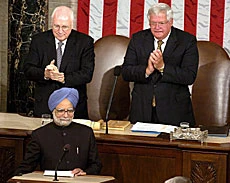
The relationship is currently in its best shape in decades. This was obvious when US lawmakers cheered Manmohan 32 times during his 40-minute speech. Elegantly dressed in a black “band gala” (waist-long coat) and wearing a light blue turban, the prime minister received two standing ovations both as he entered the hall to deliver his address and when he finished it.
Bush’s offer to help India’s civilian nuclear program comes even though India has refused to sign the Nuclear Nonproliferation Treaty.
Bush said Monday that he is committed on getting Congress to approve changes in US law that would allow the United States to help with India’s civilian power program, including the possibility of supplying fuel for the country’s nuclear reactors at Tarapur near Bombay.
“Cleaner energy resources, including nuclear power, are vital for the future of both our economies,” Bush said.
Elaborating on Indo-US collaboration, Manmohan also said a new initiative in agriculture would focus on basic and strategic research for sustainable development in agriculture to meet the challenge of raising productivity in conditions of water stress, and how to promote technologies that minimize post- harvest wastage and improve storage, and help Indian farmers to fully participate in global farm trade.
Later during a luncheon for Manmohan and his wife, Gursharan Kaur, Secretary of State Condoleezza Rice said: “We welcome India as a global partner, and we look forward to the continued strengthening of democratic institutions, values and peace because this partnership will prosper and move forward.”
Still, the US-India friendship clearly has its limits: As expected, Manmohan failed to win Bush’s support for India’s bid for a permanent seat on the United Nations Security Council.