WASHINGTON, 29 July 2005 — American Muslim religious scholars who interpret religious law for their community issued a formal ruling yesterday condemning terrorism and forbidding Muslims to cooperate with anyone involved in a terrorist act.
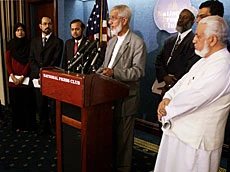
The Council on American-Islamic Relations (CAIR) held a news conference yesterday in Washington, D.C., to announce that a fatwa against terrorism and extremism had been issued by the 18-member Fiqh Council of North America (FCNA) and endorsed by major US Muslim groups.
The FCNA, an association of Islamic legal scholars, wrote that people who commit terrorism in the name of Islam were “criminals, not ‘martyrs.’”
“There is no justification in Islam for extremism or terrorism,” the scholars wrote. “Targeting civilians’ life and property through suicide bombings or any other method of attack is haraam — or forbidden.”
The US fatwa does not specifically address suicide bombings in a war, but the scholars barred Muslims from helping anyone “involved in any act of terrorism or violence.” The council also said Muslims were obligated to help law enforcement officials protect civilians.
“It is the civic and religious duty of Muslims to cooperate with law enforcement authorities,” said the Fiqh Council.
Already in New York and other cities, mosque leaders have joined advisory committees created by the FBI to build relations between law enforcement and their local communities.
The Fiqh Council is made up of the Islamic Society of North America, the Islamic Circle of North America, the Muslim American Society, and the American Muslim Association of North America.
“We pray for the defeat of extremism and terrorism,” the scholars wrote. “We pray for the safety and security of our country, the United States, and its people. We pray for the safety and security of all inhabitants of our planet.” Islam has no central authority and the council serves an advisory role for American Muslims, who are estimated to number as high as 6 million here.
Dr. Sayyid Mohamed Syeed, Secretary General of the Islamic Society of North America, or ISNA, based in Chicago, Illinois, said the decision to issue today’s fatwa was based on the need for all US Muslim organizations to unite against terrorism.
“We have been forcefully condemning — through all the means that we have — the act of terrorism wherever it has been. But we thought it is also important that we bring our scholars of Islamic theology together, in a clear and united voice, to condemn these acts of terrorism. This would make clear to everyone within Islam, and outside the Islamic community, that there is no basis whatsoever for acts of terrorism in Islamic scriptures and Islamic theology.”
Dr. Syeed said that in addition to the condemnation of these terrorism acts, “we have been using every recourse at our disposal to define ourselves, as Muslims in America, in term of our mission to represent the positive aspect of Islam.”
In response to the fatwa, Imams across the country have agreed to focus today’s Friday sermons on the religious duties of all Muslims to work against the dark forces of hate and violence rooted in terrorism.
“We are taught in the faith ‘to resist evil with our hands, or our mouth, or at least in our heart, and the latter is the least of faith,’” said Muslim American Society Executive Director Mahdi Bray.
CAIR also announced plans to release a TV ad and a petition-drive called “Not in the Name of Islam,” which denounces terrorism.