
Maybe that’s why the name of Bombay was changed to Mumbai, to avoid the pronunciation mistakes,” a couple of Indian tourists who joined my tour from Rome suggested.
Do not mistake the place with Bombay in India; they are not even on the same continent.
Pompeii lies near the foot of the volcano Vesuvius, overlooking the River Sarno Valley a 20 miles south of Naples in western Italy. The Italian guide Antonella Mazzarella told us that Pompeii is a treasure trove for archaeologists and anthropologists because this ancient Roman town was kept safe from changes for 13 centuries under a thick layer of volcanic ash.
Cruising along the Autostrada del Sol (Highway of the Sun), Mazzarella explained in three different languages as we passed by the Abbey of Montecassino, that it was reconstructed after being damaged in World War II.
As we reached Naples, we stopped to admire the countryside and the seashore. We also visited an old factory called Torre del Greco that produces and sells cameos and works of coral.
Umbrella pines, cypresses and lush green trees welcome us to the city of Pompeii and these tall green natural sculptures continue to please our eyes wherever we turn our heads.
Ferdinando Fiocco, our second guide to the city, narrated what a tragedy it was that the green mountain which had offered its forests and vineyards to the inhabitants of Pompeii turned out to be a lethal volcano.
The eruption of Vesuvius in 79 AD buried the entire city six meters deep in volcanic ash. “Although many managed to escape, most of them could or would not,” he said. They were killed either by the poisonous gases and the rain of volcanic material or by the collapsing buildings.
Pompeii remained buried until the end of the 15th century, when traces of the city were brought to light. In 1748, the king of France, Charles of Bourbon, ordered a thorough excavation of the site. The impecunious king financed the endeavor by raiding the churches of neighboring Italian cities. Gold, silver and other ornaments were all mercilessly collected by the French armies. The excavation revealed the archaeological treasure Pompeii, a city that at the time of the eruption was only 500 meters from the sea, but which is now over two kilometers away.
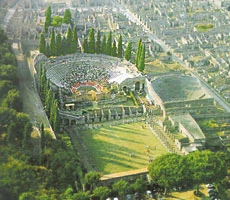
The guides were very informative in explaining every aspect of ancient Roman life in Pompeii. We were shown the largest theater of the time, which was supported by a framework of piers and vaults. According to the standards of Roman architecture, the way the theater was built indicates that it was designed to be situated at the heart of the city. We sat on the same white marble blocks as some of the ancient aristocrats, with the same view of the circle-shaped stage.
Next to the theater lies Odeon, purpose-built for musical rehearsals, recitation and mimes. The theater could hold 5,000 people whereas Odeon only took 1,000 spectators.
Tourists marveled at the petrified shapes of dogs and humans that still remain. The shapes were naturally formed castings made by the ingress of calcium rich fluids into the cavities in the hardened volcanic mud. The preserved detail was incredible; some imprints of bodies even showed belts with a name engraved. The belts were worn by slaves and the name engraved was that of their masters.
Decorated villas hint at the luxurious lifestyle enjoyed by wealthy Pompeians. The Villa of Poppea belonged to the Poppea Sabina, the second wife of Emperor Nero. Queen Poppea Sabina was descended from an influential family and was said to be very beautiful.
The large house has one side slightly elevated where a theater, complete with a stage and three entrances, was constructed. A domestic chapel attests to private worship of the Egyptian divinity Isis. A treasure chest, containing expensive jewelry that can now be admired in Museo Archaeologico Nazionale di Napoli, Naples’s Archaeological National Museum, was found in the queen’s house.
Her privileged lifestyle was abruptly ended as the emperor kicked the beautiful queen to death after she complained of his coming home late from gladiator shows.
The longest road in Pompeii was our next destination; it was once lined with shops, bars and bakeries.
“May I introduce you to the first McDonald take away?” Fiocco joked. He explained that ancient Romans had more than 90 bars in the town, something which he thought revealed their fondness for socializing, eating and drinking.
Roads were perfectly constructed for both carriages and pedestrians. A German tourist queried the blocks of marble in the middle of the streets. They were intended, said Fiocco, to allow people to cross the roads without getting wet when they were flooded. The narrow spaces between the stones were measured for width between carriage wheels. To help pedestrians find their way along the dim streets at night, small squares of glowing white marble that glowed white in moonlight, were inset along the roads. Marble was widely used in the construction of Pompeii; the most popular was gleaming white, shipped from Greece and Asia.
Pompeians used marble to decorate floors, walls and fountains. Pompeii had many fountains; there is even a house named after one. The House of the Large Fountain is exactly what it says; it is a house with a giant fountain. Its basin is covered with marble plates and the archaeologists were faced with a challenge to recover the marble and the mosaic decorations but managed to do so wonderfully. The beautiful decorations and ornamentations are evidence of the Romans’ esthetic talent. Fountains and wells outside the houses were built so that even horses would be able to drink from them. The water in the city’s channels changed automatically, so that it would always be fresh.
The city is filled with splendid portraits that are found in private homes, in shops and in public areas.
Another proof of luxurious living is the public baths. They were generally made up of a suite of dressing rooms and bathing chambers with hot, or caldaria; warm, or tepidaria; and cold, frigidaria baths next to a gymnasium and a larger pool for swimming.
Archaeologists agree that not all treasures of Pompeii have been fully discovered. Substantial areas of the site still remain to be excavated. A city kept hidden in secrecy for over 1300 years not only evoked the interest of my fellow visitors, it fascinated us and it is safe to assume that it will fascinate many more.