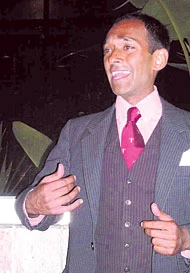
JEDDAH, 7 August 2005 — There is a special breed of infectious enthusiast that makes you feel weak simply by being near their enormous energy. Adel Anwar, the son of an expatriate medical doctor who has worked in the Kingdom for half a century, is one.
Born in the Kingdom, he cheerfully admits he didn’t really match up to the family expectations of a glittering academic career in his first outing to primary school. “I lasted a day,” he said. “The authorities were not best pleased when I smashed a drinks bottle in a tantrum.”
He ended up in a boarding school in the UK — and there he stayed all the way through his education. “It was a tough environment,” he said. “The discipline was rigorous and externally imposed. I was rather expected to get glittering grades and succeed, given the strong academic background I had come from.”
Anwar did sufficiently well to get into and through university — so far, an ordinary story of a child sent overseas for education in a disciplined environment.
Never much interested in sports, he took up taekwondo — a modern martial art from Korea that is characterized by its fast, high and spinning kicks. He immediately clicked with its discipline and became the UK Student Champion, by using special strategies for both physical and mental aspects of competitive life. One was technique that enabled him to instantly access courage and keep calm, during stressful moments in the ring.
“That got me thinking about the effectiveness of mind strategies,” said Anwar. “If I could strike gold in taekwondo, could I do it in other areas of life?”
The answer came when a lawyer colleague introduced him to the learning needed for law. “I managed to inveigle my way into law school and developed strategies for rapidly mastering what was needed. It soon became obvious that specialized learning techniques were the key to turning an ordinary individual, like myself, into a successful results-orientated person.”
Anwar qualified as a barrister at law. During that time, he continued to research practical psychological techniques to produce rapid results, and developed his own methodologies for improving memory and increasing motivation.
“I saw that rapid learners were the highest earners in business,” he said. It was also clear that many skills are learnable. Techniques for acquiring knowledge and using them faster than a competitor often creates financial growth, whether it is through promotion or beating another business by producing better results.
“It boils down to strategies for learning rapidly and thinking creatively” he said. The brain is an organ that improves with special training. “It’s a sleeping giant or largely unused supercomputer; you just have to learn how to awaken it.”
Anwar thinks that we are born with this supercomputer hard-drive installed, but with no guide. After spending thousands of hours investigating the latest scientific breakthroughs relating to the brain, he started to develop a user’s manual or superior software for the computer, “I was born with a normal brain but learnt how to ‘unlock it’ to produce higher results in life, quicker than others.”
Drawing on his experience in the Kingdom, Anwar recalled that before the age of printing, most knowledge was passed on orally. “This involved prodigious feats of memory by classical and Arab scholars,” he said, “and this was considered unexceptional. We see it occasionally today with the hafiz — those who learn the entire Qur’an by heart.”
As if to prove the point, Anwar got himself into the Guinness Book of World Records for his feats of memory.
Over the last few years, Anwar has developed his set of unique strategies, including “accelerated learning” techniques, using ideas from management science like ‘Six Sigma’, ‘Continuous Improvement’ and the modern buzzword ‘Leadership Development’ — to develop an individual style which he presents to corporations all round the world.
“It was a dream come true,” he said. “Traveling the world and sharing strategies that allow just about anyone to use their brains and develop their full potential is enormously exciting’” he said. “Learning potential is proportional to earning potential.”
The downside of this success is that he spent little time with his family in the Kingdom.
It was as a result of his presentations in California that Saudi businessmen in the state contacted him. When he came to the Kingdom recently, to catch up on long overdue family visits, he re-established those contacts and ended up giving major presentations for the local chamber of commerce to an auditorium of around 500 Saudi businessmen.
“It was humbling,” said Anwar. “The level of interest was incredible. Not a single person left the room, but instead sat at the edge of their seat. I had this terrific feeling of delivering new knowledge to businessmen eager and willing to learn.”
Anwar demonstrated his own incredible brain power by memorizing hundreds of words and numbers that the audience called out to him; he recalled them all. The delegates, visibly impressed by the prodigious feat of memory, were introduced to the techniques that unlocked their own brain power, so that every member of the audience could almost instantly develop a “photographic” memory. Anwar emphasized that this is merely one skill out of a handful that he presents, because it enables a superior businessman to lead in the new age of “information explosion.”
After the event, some of the delegates had, by using techniques shared by Anwar, took some simple tests and demonstrated to their own incredulity that their memory had improved by over 500 percent. “They were stunned,” he said, “but hugely encouraged.”
Developing this kind of potential to acquire and utilize technical knowledge is no simple party trick. “The ability to learn rapidly in order to keep ahead of ferocious competition is vital in today’s knowledge-based economy,” said Anwar. “My father, Dr. Abdul Baki Anwar, has spent most of his life here. In medicine, he knows the usefulness of the ability to think and act swiftly in an emergency. This applies in business too, because we all need to continually upgrade our knowledge if we are to survive and financially thrive in the Information Age.”
Anwar believes that training people with specialized strategies like “effective thinking” has measurable financial benefits in their life. “Having been born here, I think of it as a full circle; I believe I am bringing something of great worth back to the culture that nurtured me.”