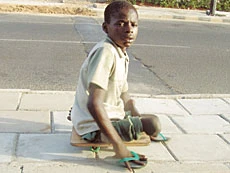
JEDDAH, 10 August 2005 — Al-Moraba Bridge, just north of Tahlia Street, is a favorite congregating point for beggars and street peddlers. For more than 18 hours a day, they walk the lanes between the cars, peddling their wares or pitifully displaying various deformities — not unlike fashion models strutting down the runway. If real, the missing limbs and burned bodies did at one time cause the individuals a great deal of pain and suffering — so many people naturally sympathize.
Gangs of beggars are all over Jeddah, and according to the Anti-Beggary Department, some babies are often intentionally disfigured at a young age in order to evoke sympathy. Ethiopian TV recently featured a man who was arrested and convicted of intentionally blinding children with a fork, then pushing them out onto the streets to beg.
Historically, the intentional maiming of human beings is nothing new. Though no longer done, children in Mali and Niger 50 years ago had limbs amputated by warlords to prevent the children from growing and fighting against them.
Many Africans taken to America as slaves were “hobbled” — having one leg intentionally broken near the ankle to prevent escape. Left untreated, the slave was never able to run again. Some had their foot amputated.
The large number of boys and girls with hideous deformities at Jeddah’s traffic intersections and bridges suggests that such cruelties may be happening here in Saudi Arabia. Though no statistical data exists to prove or disprove the suggestion, the Anti-Beggary Department admits that it is always on the lookout for those who might be engaged in such practices.
For many, seeing a deformed child brings thoughts of one’s own children to mind — and the person sympathetically reaches for his or her wallet. Some momentarily question whether the afflictions just inches away on the other side of the window are real. According to Islam, however, it doesn’t really matter as the reward from God comes from the intention behind the act of giving — not whether the person receiving charity is in genuine need or not. Research has shown that the crippled, disfigured and the elderly evoke the greatest sympathy and, therefore, receive the most money.
A Monday-night encounter with a 12 year-old beggar and his minders proved that some beggars fake their afflictions in order to gain sympathy and money.
While seated in a westbound car with a friend on Al-Moraba Bridge, we watched the boy limp toward us as we waited for the light to change. His right leg was positioned at a strange angle, preventing his foot from reaching the ground and his knee was twisted away from his body.
Logic will tell you that an injured leg, displayed for all to see, should be withered since it was supposedly incapable of reaching the ground to support his weight. This was not the case here. Curiously, the muscles in the “withered” leg appeared to be well-developed, like those of a soccer player, and this gave rise to the idea that the little beggar was preying on people’s good will, and taking everyone at the traffic light for a ride.
Parking below the bridge, this journalist walked up the pedestrian stairs and approached him on the deck. When he realized someone was heading in his direction, the “handicapped” boy suddenly straightened his crippled leg and bolted for the southeast corner of the bridge with Arab News close behind. His leg miraculously cured, he was running down two stairs at a time. Caught midway down, he agreed to an impromptu interview. However, before many words were exchanged, two “minders” appeared.
From behind, a young man dressed in a thobe, perhaps 17 years old, suddenly appeared and demanded in a Yemeni accent that the “miracle” boy be released. Seconds later, another boy, perhaps 14, joined the group and he also became aggressive. The cornered beggar began to cry; then, as if on cue, all three suddenly ran off in different directions. The young beggar was last seen southbound on foot, athletically running down Al-Moraba Bridge past the Jeddah International Market and the Meridien Hotel, toward Tahlia Street.
The anti-beggary patrol often have a difficult time organizing raids on Al-Moraba Bridge as there are 12 different ways to go up and down, thus providing a choice of escape routes. Covering the bridge from all sides simultaneously is difficult and requires the use of several officers, exactly what the beggars’ minders are on the lookout for.