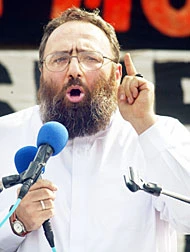
LONDON, 10 August 2005 — A growing debate started yesterday whether Home Secretary Charles Clarke should allow Omar Bakri Mohammed, the leader of the radical group, Al-Muhajiroun, back into the country, after it became known yesterday that the radical cleric had quietly slipped out through Heathrow Airport on Monday for “a holiday in Lebanon”.
Bakri came to Britain in 1993 seeking asylum after fleeing from his native Syria and was granted indefinite stay (the officialspeak for permanent residence).
Clarke has ample powers under existing laws to ban Bakri’s return to the UK under an exclusion order “on grounds conducive to the public good.”
Permanent residence does not carry the same rights as British citizenship.
Early yesterday, Bakri, speaking to the BBC from Lebanon, stressed that he was “going to return to the UK in about four weeks. My family — my wife and seven children — are still there. I did not flee from the UK. I left on my own passport with my own name. I don’t want to come if the British government does not want me to return. I don’t want the British government to use Al-Muhajiroun and Omar Bakri to terrorize the Muslims in Britain with new laws and measures.”
Bakri has courted controversy over the last few years especially after the 9/11 attacks on US landmarks in 2001. He has attracted attention with his extreme remarks, allegedly praising the 9/11 terrorists, as “the magnificent 19”.
Ironically, he has never been charged or convicted by a British court.
But Labour MP Andrew Dismore said that he did not think the Home Secretary should allow the controversial self-styled cleric back into the country.
“If you remember he came to UK seeking refuge from the Middle East. If he can now go there for a holiday, then he can stay there. The Muslim Council of Britain (MCB) are rejoicing at his departure.”
The MCB’s Sir Iqbal Sacranie, quoted by the local media, said that Bakri’s departure “would bring joy and happiness to the UK’s Muslim community”.
Mainstream Muslim organizations have always denounced Bakri’s views, saying that neither he nor his organization represent the true voice of Islam.
But there is serious doubt and confusion over what legislation the government should use to combat such radical preachers.
Last week Prime Minister Tony Blair announced sweeping new measures aimed at extremists who abuse British hospitality. Blair confirmed that the government intends to ban both Al-Muhajiroun and Hizbut Tahrir.
On Sunday, the Lord Chancellor, said that extremists may be charged under treason.
Yesterday, the government said that special courts sitting in secret for pre-trial hearings in terror cases are being considered by the Home Office. Judges would look at whether there was enough evidence against suspects for cases to proceed.
Blair has said a new court procedure allowing pre-trial hearings could allow police to detain suspects for longer before charging them. “We are already examining a new court procedure which would allow a pre-trial process. We will also examine whether the necessary procedure can be brought about to give us a way of meeting the police and security service request that detention, pre-charge of terrorist suspects, be significantly extended,” he said.
The government’s anti-terror proposals have come under attack from its own backbenchers and from some senior lawyers.
Labour home affairs committee chairman John Denham has called the government’s anti-terror plans “half-baked” and confused. Ian Macdonald QC, who resigned last year as a barrister in special terror cases, said he thought the secret courts proposal might be botched, because it was not clear whether the government was adopting a French-style system of investigating judges or more likely simply looking for a way of extending the time terror suspects were held.
Police Quiz Osman Hussain
Scotland Yard detectives yesterday started questioning Osman Hussain, the fifth failed 21/7 London bomber, after gaining access to him for the first time in the maximum security Regina Coeli prison in Rome, where he is held pending an extradition hearing on Aug 17. The questioning went on for more than three hours, concentrating on the circumstances and reasons for the attack.
Scotland Yard confirmed that anti-terrorist branch detectives are in Rome in connection with an investigation into a terrorist suspect wanted in the UK for the failed bombings on London transport system on 21 July.
British police are confident that the decision on Hussain’s extradition to the UK would be taken quickly, although it is almost certain that the terror suspect’s lawyer will appeal against any decision that goes against him.
The lawyer, Maria Antionetta Sonnessa, has vowed to fight the extradition at all costs and wants her client to be tried in Italy on lesser charges of connections with terrorism and possession and the use of forged documents.
The questioning took place in front of the Italian judge, Domino Michelli, who will preside over the hearing, and Hussain’s lawyer Sonnessa.
Hussain had the option of refusing to respond to the questioning, but his lawyer confirmed that he repeated the same answers he gave to Italian police, that the attempted bombing in London “was not meant to kill anyone, but was done as a protest action.”
Scotland Yard has emphatically dismissed the claim and stressed that had the bombs gone off the destruction and death would have been on the same scale as the 7/7 attacks.
The four other suspects in the 21/7 bombing plot, Mukhtar Said Ibrahim, Ramzi Mohammed, Yassin Hassan Omar, and Manfo Kwaku Asiedu, were all remanded in custody on Monday and sent for trial at the Old Bailey on Nov. 14, after appearing before Bow Street magistrates at the specially-convened high security Belmarsh Magistrates Court at Belmarsh Prison in south east London.
Nine other people, including the common law wife of Osman Hussain, Yeshiemebet Girma and her sister Mulumebet, have also been remanded in custody till Aug. 11 on lesser charges of failing to disclose information about terrorists to the police.